
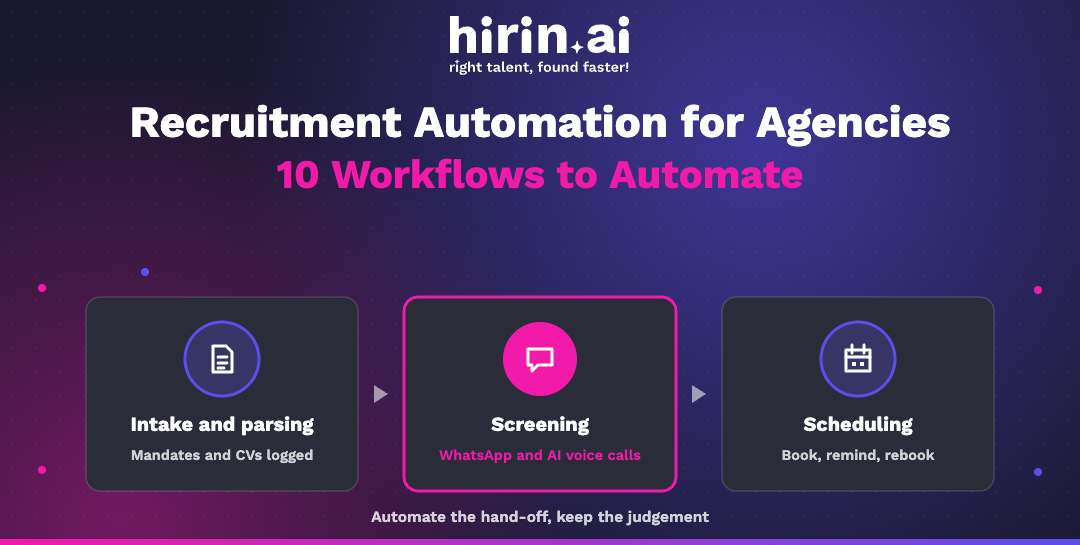
The recruitment outsourcing and staffing industry is at a turning point. Recruitment is the process of actively seeking the right talent to fill specific positions. Sourcing, screening, and interviews run in a circle at staffing agencies. However, given the rapid development of the job market, traditional talent acquisition methods are becoming insufficient.
In 2025, leveraging artificial intelligence (AI) and automation has shifted from a competitive advantage to a core necessity for growth. Recruitment Process Outsourcing (RPO) providers and staffing agencies are now using automation to tackle high-volume hiring, tight SLAs, and intense margin pressure.
AI recruitment solutions like Hirin.ai, for example, automate screening, scheduling, and assessments, promising up to 70% faster time-to-hire (and better candidate matches).
Despite all the benefits, the biggest fear among recruiting agencies is
being replaced by such AI recruiting software. So, let us explore what recruitment automation means, why it’s essential, and what RPO and staffing service providers can expect in return!
What Is Recruitment Automation?
Recruitment automation means using technology to establish automated workflows for repeatable tasks that HRs and recruiters otherwise handle manually. For example, sourcing, screening, scheduling interviews, and more, you can automate using AI recruitment software or AI recruiting agents.
- Having recruitment automation in place means having a tireless assistant that:
- Auto-post and source across boards, job sites, and talent pools. No copy-paste. No busy work.
- Proactively surface passive talent from LinkedIn and niche sites. So, pipelines stay warm 24/7.
- AI-screen resumes instantly, parse skills, rank fit, and remove irrelevant applicants before recruiters see them.
- Use chatbots and SMS to answer FAQs, schedule screenings, and cut dropout rates.
- Let candidates self-book interviews; sync calendars and auto-send reminders. No back-and-forth.
- Run skills tests, async video interviews, and automated scoring for objective shortlists.
- Move candidates when rules match, not when someone remembers.
- Integrate with ATS, background-check, and payroll systems to kill tool silos and data re-entry.
- Scale consistent SLAs, multi-client workflows, and client reporting with one platform.
- For staffing agencies, automate shift bookings, temp onboarding, and repeat placements faster.
- Add analytics dashboards to show clients real ROI and SLAs met. Numbers sell contracts.
Why Staffing Firms and RPOs Are Turning to Automation in 2025
Automation isn’t a fad – it’s now table stakes. About 61% of staffing firms already use AI today (up from 48% in 2024). Three out of four agencies that haven’t adopted AI plan to do so within the year.
In other words, nearly 75% of firms will be running AI tools by the end of 2025. RPO buyers are 3.5× more likely to choose providers with AI capabilities. In short, agencies without automation risk falling behind their competition.
Why the rush? Because recruiting agencies need to overcome challenges and face intense competition right now:
High volume, tight deadlines
Many staffing agencies handle dozens of open roles at once. Clients demand fast placements. Automation cuts hours of work, helping you place faster (often 30–50% faster, as reports suggest).
Talent scarcity and skill gaps
With 85% of the workforce passive, finding the right people is a chore. AI can proactively source from job boards and talent databases, keeping pipelines full even when talent is scarce.
Cost and margin pressure
Billing rates are under pressure. Any cut in recruiting hours is a direct savings. Well-deployed automation can cut “$20–30” of recruitment labor costs, or roughly 20–30% in expenses.
Compliance & complexity
New data rules (GDPR, EEOC audits, background-check laws) make error-prone manual work risky. Automated checks and audit trails ensure compliance with 50% fewer mistakes.
Strategic differentiation
Clients and candidates expect modern tech. “Conversational AI” chatbots for candidates are already used by 55% of firms, making agencies with AI more attractive to both clients and talent.
All in all, everyone from RPOs to in-house HR is racing to automate by 2025. Those who wait, risk longer cycle times, higher costs, and poorer experiences for clients and candidates alike.
Where Automation Fits in the Recruitment Lifecycle
Automation can slot into every stage of hiring. Here’s how it typically works – and why it matters – at each step:
Sourcing and Talent Pipelining
Automatically scanning sources to fill your funnel. Instead of recruiters manually checking boards, AI tools crawl LinkedIn, job boards, and resume databases to find candidates who match your jobs. They can even auto-post jobs to multiple sites. This is critical because about 85% of potential hires are passive. Automation keeps pipelines stocked: new candidates are flagged or added to pools as soon as they appear online.
Benefits: recruiters save hours that would’ve been spent scrolling pages; pipelines stay warm automatically (no cold calls required until a good match is found).
(Example: An agency might use an AI “sourcing engine” to email qualified passive candidates as soon as matching keywords appear on resumes in the system.)
Resume Screening and Shortlisting
Filtering in seconds what used to take days. AI-powered screening tools parse resumes and rank candidates by fit (skills, experience, keywords). They eliminate irrelevant CVs instantly, leaving recruiters with a ranked shortlist. Many firms report screening time cut by roughly 50–60% through automation. That means a role that used to take 20 hours of reading can take 10 or less. Recruiters get only “green light” profiles, freeing them to interview instead of sorting.
(Example: Hirin.ai can call or WhatsApp candidates with preset questions for initial screening, and automatically rank the rest – so recruiters only see top matches.)
Candidate Communication and Nurturing
Keeping candidates engaged without manual toil. Automated email or chat campaigns update applicants on status, answer FAQs with AI chatbots, and send reminders. This responsiveness dramatically improves the experience.
For example, one study found 67% of job seekers had a more positive view of a company when they got consistent updates during hiring. Chatbots can field routine queries or schedule screenings instantly. The result is higher completion rates and lower dropouts. Candidates feel “taken care of,” and even rejected ones appreciate quick answers.
(Example: After resume submission, a candidate receives an automated note: “Thank you! We’ll review your resume and update you by X date.” Later, an AI chatbot can tell them, “Your interview is scheduled for Thursday at 3 pm.”)
Interview Scheduling and Asynchronous Interviews
End the calendar chaos. Scheduling tools let candidates pick slots based on recruiters’ open times (via a booking link), so you avoid endless back-and-forth emails. This alone can cut coordination time in half. For hard-to-reach candidates, asynchronous video interviews are a game-changer: candidates record answers to preset questions on their own time.
Recruiters view responses later at convenience. This means no more no-shows or delays – it eliminates scheduling conflicts. (In fact, coordinating calendars manually can drive up to 30% of candidates to drop out.)
Hirin.ai, for instance, offers asynchronous video interviews and question banks so that candidates can showcase their skills anytime, and recruiters get consistent, scored responses.
Assessments and Matching
Automated testing for better hire predictions. Instead of guessing skills from titles, automation can run candidates through skill quizzes, cognitive tests, or role plays online. The platform scores and highlights who passes. Meanwhile, AI matching engines compare jobs to candidate profiles using past-hire data.
The result? Shortlists become more relevant. Well-deployed automation programs often report 15–25% more placements and double-digit productivity gains, because hiring managers see only the truly qualified.
(Example: An RPO might route every candidate through a quick coding test for tech roles, automatically advancing only those who score above threshold.)
What Results Can RPOs and Staffing Agencies Expect?
With a solid setup, automation really delivers some measurable, clear-cut wins. Your recruiters get to spend way less time on the boring, repetitive stuff and more time actually chatting with and engaging that top-tier talent. And for your clients? They’re going to see faster hires, and the quality of those hires will be noticeably higher. Seriously, whether you look at it in terms of hours saved, placements you’ve added, or costs you’ve slashed, the numbers really start to climb.
Quicker Hiring Cycles: This is a big one! Companies that use smart automation are filling roles anywhere from 30–50% faster from start to finish. For example, that overall time-to-hire that used to take 60 days? It could easily drop to just 30 to 40 days. That’s huge!
More Placements: Because your recruiters are suddenly so much more productive, the top firms are seeing a jump of 15–25% more placements year-over-year. Essentially, every single recruiter is managing to do more hires without breaking any more of a sweat.
Lower Operating Costs: When you automate all that repetitive admin work, your operating costs naturally go down. You can pretty reliably expect to see 20–40% less administrative spend on recruitment (and some tools even brag about saving you 50–70% on process costs—can you imagine?).
Way Better Candidate Experience: Instant responses and round-the-clock chat support mean candidates are much happier. In fact, surveys show 45% of agencies using AI reported a better overall experience for both candidates and recruiters. Plus, when candidates get instant updates and flexible scheduling, those frustrating early dropout rates often fall by around 30%.
Stronger Compliance and Fewer Errors: Automation makes sure rules are followed perfectly, every single time. Firms commonly see error rates drop by about 50% in things like background checks and data handling. It’s just a lot more consistent and reliable.
Conclusion
Automating the right parts of recruiting is like switching from a horse-drawn cart to a sports car: you’ll get where you need to be faster, with the engine doing the hard work. To see these kinds of gains in your agency, why not book a demo with Hirin.ai? Our experts can show you how AI-driven sourcing, screening, and scheduling work in action – and how quickly you can start saving time and money.