

On this page
- What is a notice period buyout?
- How long is the notice period in India?
- What should recruiters know about the law?
- Who pays for a notice period buyout?
- What should you ask at the first screen?
- How do you keep a candidate warm through 30, 60 and 90 days?
- How do you handle counter offers and backouts?
- When is it worth funding a notice period buyout?
- When does this not apply?
- How do you measure notice period losses?
- Frequently asked questions
- How we researched this
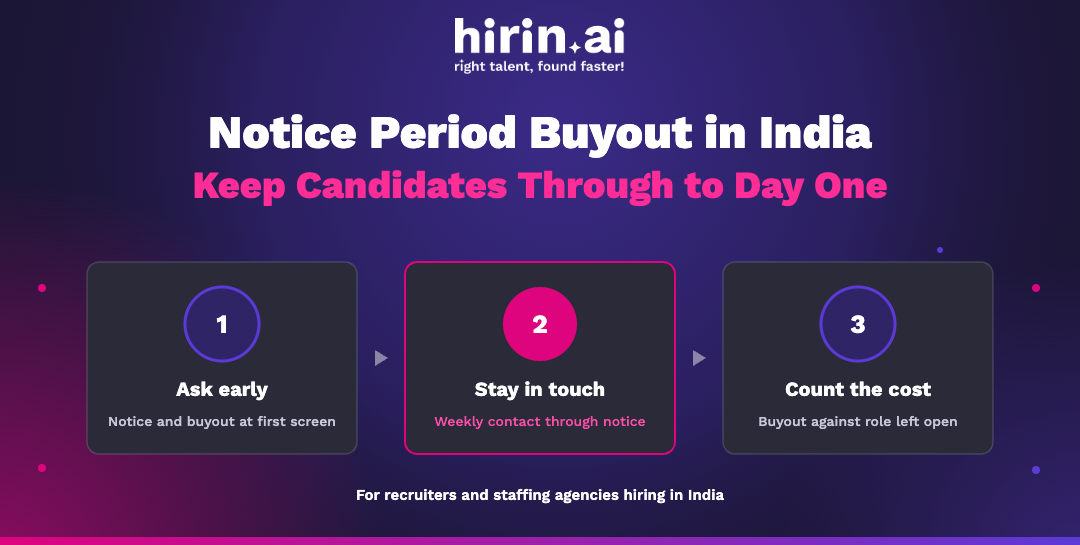
- Ask for the notice period and the buyout position at the first screen, and write both into the requisition, not just the CV.
- Plan the offer from the joining date backwards. A long notice period is a risk to price in, not a surprise to discover at offer stage.
- Backouts often come through a counter offer or silence, so contact every week of the notice period, not only at the start and the end.
- A buyout is a business decision. Compare its cost with the avoidable cost of the role staying open, using your own numbers.
- Measure offer to joining and drop outs by week of notice, so you know where in the notice period you lose people.
What is a notice period buyout?
An accepted offer is only half a placement, because the candidate still has to serve notice. A buyout is the way some employers and candidates shorten that wait. The current employer agrees to release the employee early, and the unserved days are paid for, waived or partly waived. It is a private agreement between the employee and the current employer. The recruiter is not a party to it.
For hiring teams and agencies, the notice period is where selected candidates are lost. The offer is signed, the seat or the fee is counted as won, and then the candidate takes a counter offer in week three. The fix is mostly process, whether or not you use recruitment agency software: ask early, plan around the date and keep the candidate warm.
How long is the notice period in India?
It is commonly 30 to 90 days in Indian offer letters, and it usually grows with seniority. We found no government survey with an average, so we quote none. The table lists what to confirm, not a benchmark.
| Situation | What you will often see | What to confirm at screening |
|---|---|---|
| Junior and volume roles | Shorter notice, sometimes a probation clause | Whether the candidate is on probation and what the letter says |
| Mid level and senior roles | Commonly 30 to 60 days, longer for management | Exact days, and whether leave can be adjusted against notice |
| IT and tech roles | Often a longer notice on the letter, then negotiated | Client handover duties and project dates |
| Sales roles with incentives | Varies, often tied to payout dates | Pending incentive, variable pay or bonus cycle |
These are patterns recruiters report, not statistics. For tech mandates, our guide to IT recruitment covers planning around longer notice.
What should recruiters know about the law?
This is a practical summary, not legal advice, and we are not lawyers. We found no primary source that sets a standard notice length, so treat the contract or appointment letter as the starting point and ask an employment lawyer if a case turns on anything else.
The Labour Codes add a point to check. The Press Information Bureau announced on 21 November 2025 that the four Labour Codes were being made effective from that date, rationalising 29 existing labour laws. The same release says that during the transition, the relevant provisions of the existing labour Acts and their rules will continue to remain in force [1]. So confirm the current notified position before relying on an older Act or on a Code rule.
Section 27 of the Indian Contract Act, 1872 says every agreement by which anyone is restrained from exercising a lawful profession, trade or business of any kind is to that extent void, with one exception for the sale of the goodwill of a business [2]. How it applies to a notice clause or any other restriction depends on the wording and the facts. That is a question for a lawyer. Do not tell a candidate that a clause will or will not hold. Say the letter governs and suggest they take their own advice.
Who pays for a notice period buyout?
It is settled case by case. We found no primary source that sets a rule, so this is how it tends to be arranged, not what the law requires. The current employer decides whether to release the person at all. If it does, the unserved days can be paid by the candidate, by the new employer or split between them. How a buyout is taxed can differ for each side, so ask your finance team or tax adviser before you promise anything.
| Who funds it | Why it happens | Watch out for |
|---|---|---|
| New employer pays | The role is urgent and the candidate is strong | Set a clear condition, such as joining by an agreed date, in writing |
| Candidate pays | The candidate wants an earlier start | The recruiter should not pressure or advise on this |
| Shared | Both sides gain from a shorter wait | Agree the split before the offer is signed |
| Waived by the current employer | Handover is done | Get the relieving date confirmed in writing |
Agencies should check how the client agreement treats a delayed joining, as some fee terms depend on it. Our guide to recruitment agency fee structures explains the usual models.
What should you ask at the first screen?
"About two months" can mean 60 days, or 90 days with leave to adjust. Ask the same questions in the same order for every candidate and record the answers in one place.
- Ask for the exact notice in days. Ask them to check the letter and tell you the number.
- Ask whether any days can be served by leave. Unused leave sometimes shortens the real wait.
- Ask if the employer has released people early before. The candidate will know if colleagues left sooner.
- Ask about pending pay. A bonus or incentive due after the notice date is a reason to stay.
- Ask if they are open to a buyout, and who would fund it. Treat the answer as information, not a promise.
- Note who else is talking to them. A candidate with two other processes will not wait quietly for 90 days.
How do you keep a candidate warm through 30, 60 and 90 days?
The aim is not to chase. It is to stay useful and visible, so that when a counter offer arrives you already know. Use short messages at set points, on the channel the candidate uses, which for many candidates in India is WhatsApp. Adjust the plan to the notice length in the letter.
| Stage | 30 day notice | 60 day notice | 90 day notice |
|---|---|---|---|
| Offer accepted | Confirm resignation date | Confirm resignation date | Confirm resignation date and ask about buyout |
| Resignation submitted | Ask for the acceptance and relieving date | Same, plus a call from the hiring manager | Same, plus a call from the hiring manager |
| Weeks 1 to 2 | One check in, share the joining checklist | Weekly short message, share the team intro | Weekly short message, invite to a team call |
| Middle of notice | Check for counter offer, confirm documents | Call to check for counter offer, confirm documents | Call every two weeks, share a first month plan |
| Final 2 weeks | Confirm last working day and joining date | Confirm last day, send reminders | Confirm last day, send reminders, line up the induction |
| Day before joining | Reminder with address, time and who to meet | ||
Three habits matter more than the schedule. Let the hiring manager call, because the future manager carries more weight than any recruiter message. Tell the candidate what happens on day one. And make it easy to say "something has changed", because candidates who feel judged go quiet.
Stay in touch until day one
Hirin.ai checks in with candidates on WhatsApp through the notice period, flags a counter offer mention or a few days of silence, and keeps backups from the same shortlist warm. Your recruiter makes the call.
How do you handle counter offers and backouts?
Expect a counter offer, such as more money, a new title or a promise. You cannot stop it. You can make it less likely to work.
- Ask at the screen why the candidate is leaving. If the reason is not money, a pay match will not fix it.
- Ask, before the offer, what they would say if their manager matched the number.
- Watch for signals: slower replies, a changed joining date, a request to revise the offer letter.
- When a signal appears, a person on your team should call the candidate the same day.
Plan for some drop outs too. Over 60 or 90 days some are normal. Keep the next two or three candidates from the same shortlist engaged with honest updates. Your own database is the quickest source, since a talent pool of people who already know you can fill a gap in days. If the client needs someone by a fixed date, count back from it, check the notice and decide early whether a buyout or a different candidate is the safer route.
When is it worth funding a notice period buyout?
Fund a buyout only when the candidate and the current employer have both agreed, and when the avoidable cost of the role staying open is higher than the cost of the buyout. Value lost time as contribution or avoidable cost, such as interim cover, never as billing or revenue. Every figure below is illustrative and invented. None of it is data, a benchmark or a price from any vendor. Replace each with your own.
| Illustrative example: assumptions (invented figures) | ||
|---|---|---|
| Input | Case A: high contribution role | Case B: interim cover in place |
| Notice remaining | 60 days (2 months) | 60 days (2 months) |
| Buyout releases the candidate | 30 days early (1 month) | 30 days early (1 month) |
| Buyout cost for those 30 days | ₹1,00,000 | ₹1,00,000 |
| Monthly cost of the role staying open | ₹1,50,000 contribution lost | ₹40,000 avoidable cost of interim cover |
| Chance of drop out, full notice | 20% | 20% |
| Chance of drop out, shortened wait | 10% | 10% |
| Extra vacancy if a drop out happens | 1.5 months | 1.5 months |
Without the buyout the role stays open 2 months. With it, 1 month, plus the buyout. Each drop out adds 1.5 months, weighted by its chance.
| Illustrative example: results (invented figures) | ||
|---|---|---|
| Line | Case A | Case B |
| No buyout: 2 months open | 2 × ₹1,50,000 = ₹3,00,000 | 2 × ₹40,000 = ₹80,000 |
| No buyout: expected drop out cost | 20% × 1.5 × ₹1,50,000 = ₹45,000 | 20% × 1.5 × ₹40,000 = ₹12,000 |
| Total without buyout | ₹3,45,000 | ₹92,000 |
| Buyout: 1 month open | ₹1,50,000 | ₹40,000 |
| Buyout: cost of the buyout | ₹1,00,000 | ₹1,00,000 |
| Buyout: expected drop out cost | 10% × 1.5 × ₹1,50,000 = ₹22,500 | 10% × 1.5 × ₹40,000 = ₹6,000 |
| Total with buyout | ₹2,72,500 | ₹1,46,000 |
| Saving from the buyout (negative means it costs more) | ₹72,500 | minus ₹54,000 |
The break even is where both totals match. Without a buyout the cost is 2.3 times the monthly figure (2 months plus 20% × 1.5). With one it is 1.15 times that figure (1 month plus 10% × 1.5), plus ₹1,00,000. Setting them equal gives about ₹86,957 a month. Above that, the buyout is cheaper in this example. Below it, waiting is cheaper.
Two cautions. The drop out chances are assumptions, not research. The figures also leave out other costs your finance team counts, such as a joining bonus or a recruiter fee. Write the comparison down before you agree.
When does this not apply?
- Very short notice. A 30, 60, 90 day plan is overkill. Keep a simple check in.
- Client or employer limits. Some clients will not pay for buyouts, and some candidates cannot be released early whatever you offer. The current employer decides.
- Legal questions. This post is not legal advice. Disputes over notice, bonds or restrictive clauses belong with a lawyer who has read the contract.
- No figures of your own. The maths only helps with your own costs.
- Candidate preference. Some people want to serve full notice and leave on good terms. Respect that, and plan for the date.
How do you measure notice period losses?
Our guide to the offer to joining ratio covers the headline ratio. This is the notice period view of it.
- Offer to joining, by notice length. Split offers into 30, 60 and 90 day groups. If the longer groups lose more people, spend effort there.
- Drop outs by week of notice. If losses cluster in one week, move your check in to just before it.
- Reason for drop out. Counter offer, another offer, personal reasons, no reply. Use a short fixed list.
- Buyouts agreed and joined. How many were funded, and how many of those candidates joined on the agreed date.
- Backups used. How often a warm backup saved the mandate, and how many days it saved.
Frequently asked questions
What is a notice period buyout?
How long is a typical notice period in India?
Is the notice period in India fixed by law?
Who pays for a notice period buyout?
How can recruiters reduce backouts during the notice period?
How we researched this
The break even example uses invented figures and is not customer data. The notice length table lists questions, not statistics, because we found no primary source for typical notice lengths. We could not open the Industrial Employment (Standing Orders) Act on indiacode.nic.in or any page on how a buyout is taxed, so neither is covered. The two legal points below were checked on 15 Nov 2026. Hirin.ai product statements come from its recruitment agency software page.
- Press Information Bureau, Government of India implements four Labour Codes (21 Nov 2025; effective date of the four Labour Codes and continuation of existing provisions during transition).
- Government of India, Indian Contract Act, 1872, Section 27, agreement in restraint of trade, void (text of the section as published on Indian Kanoon).

Vikas Agarwal
Vikas Agarwal is the founder of Hirin.ai, an AI recruitment platform that screens, interviews and shortlists candidates for Indian hiring teams and staffing agencies. He has spent years building digital products and now works on the hiring problems recruiters raise every day. He writes about AI in recruitment, staffing and the future of work.