

On this page
- What should an English test for BPO hiring actually measure?
- What does the CEFR tell you, and what does it not?
- How do you score fluency, pronunciation, grammar, listening and call handling?
- Where should the pass mark sit?
- Worked example: how does the cut score change your pass rate and workload?
- How do you stop the test from filtering out good people?
- When this does not apply
- How to measure it
- Frequently asked questions
- How we researched this
- Test what the agent does on a call: listen, speak clearly, follow a process and recover when a customer is upset. A grammar quiz covers only one of those.
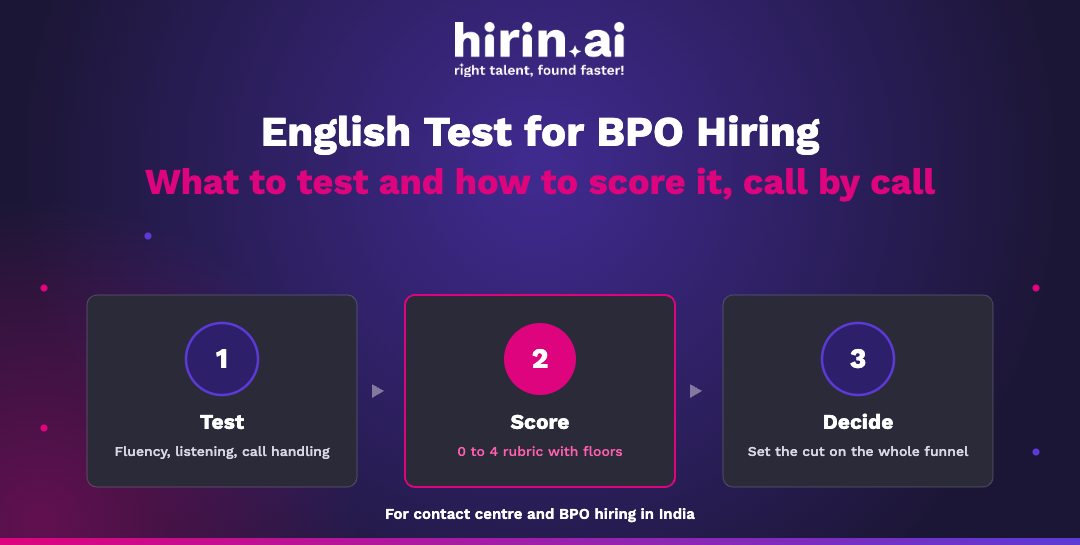
- Score five dimensions on a 0 to 4 rubric written before the first test, with anchors a second reviewer can apply the same way.
- Use a weighted pass mark plus minimum floors. In our illustrative example, a candidate with a 78.75 weighted score still fails because listening scored 1.
- Pick the cut score by looking at the whole funnel. A looser cut lowers the people you test but raises the interviews your ops team must run.
What should an English test for BPO hiring actually measure?
An English test for BPO hiring is not a check of how impressive someone's English sounds. It is a check that a person can run a customer call in English for a full shift, understand what the caller says, and be understood in return. That is a narrower and more practical bar than "good English", and it is the one your client's trainer will apply in their own voice round.
You can run this on paper, on a recorded call or through AI skill assessment software where you define the criteria and the platform scores each response against them. Either way the design is the same. This sits inside the wider process in our BPO recruitment guide, and role by role sample questions are in skill assessment tests by role. Here we go deeper on one thing: what to test for English voice and chat processes, and how to turn it into a score you can defend.
Five dimensions cover most of what decides whether a new agent survives the first month on the floor.
- Fluency. Can the candidate speak in connected phrases at a steady pace, without long stops to search for words?
- Pronunciation. Not accent. The question is whether a customer on a noisy line understands the first time.
- Grammar. Enough control of tense and sentence structure that replies are clear and professional, not perfect.
- Listening. Can they catch a name, an order number or a complaint said at normal speed, and answer the question that was asked?
- Call handling. Can they follow a process, show empathy, and recover when the customer is angry or the answer is not in front of them?
For chat and email processes, swap pronunciation for written tone and spelling. Shift, commute and joining date are still checked before the offer.
What does the CEFR tell you, and what does it not?
Clients and test vendors often quote CEFR levels. The Council of Europe's Common European Framework of Reference for Languages organises proficiency into six levels, A1 to C2, grouped as Basic, Independent and Proficient users, and defines each level through "can do" descriptors (Council of Europe, CEFR level descriptions). It is a useful common language when a client says "we need B2 spoken".
It is a general framework, though, not a call centre standard. It does not tell you whether someone can calm a caller or read back an account number. And one overall level can hide uneven skills. Pearson's sample score report for its Versant English Test shows this clearly: an overall score of 59 on the Global Scale of English, which Pearson maps to B2, sits on four subscores that range from fluency at 49 (B1) to pronunciation at 69 (B2+). Pearson describes the overall score as a weighted combination of sentence mastery, vocabulary, fluency and pronunciation (Pearson, Versant English Test sample score report). That is a vendor sample, not real candidate data, and it is not a Hirin result.
So look at the subscores, not only the headline, ask your client which standard its trainers use, and add a job specific call task to any standard test.
How do you score fluency, pronunciation, grammar, listening and call handling?
Score each dimension from 0 to 4: 0 for no usable evidence, 1 weak, 2 workable with coaching, 3 good, 4 strong. The anchors below are a starting point for an English voice process. The weights are illustrative: shift them to match your process, and write down your own anchors before testing anyone, so two reviewers give the same score to the same answer.
| Dimension | Illustrative weight | Test task | Score 1 (weak) | Score 2 (workable) | Score 4 (strong) |
|---|---|---|---|---|---|
| Fluency | 20 | Speak for 60 seconds on a familiar topic, such as how you travel to work | Long pauses, stops mid sentence, single words | Short phrases, some hesitation, can continue after a stall | Connected speech at a steady pace, natural pauses |
| Pronunciation (intelligibility) | 20 | Read a short script aloud: a name, a postcode, an order number, a date | Listener must ask for repeats on most lines | Understood with occasional effort; key words clear | Understood the first time, numbers and names clear |
| Grammar | 15 | Rewrite or say three sentences: past, present and future | Errors change the meaning | Errors present but meaning clear | Mostly accurate, professional tone |
| Listening | 20 | Hear a 30 second customer message at normal speed, then answer three questions | Misses the main issue | Gets the main issue, misses some detail | Catches issue, detail and the customer's mood |
| Call handling | 25 | Two minute role play: a customer was charged twice and is annoyed | Argues, goes silent or promises what policy does not allow | Acknowledges, but needs prompting to confirm details and next steps | Apologises, confirms details, states the next step and timeline, stays calm |
| Total weight | 100 | Weighted score = sum of (weight × score ÷ 4), out of 100 | |||
Record every spoken answer so a second person can score a sample again, score what was said and how clearly rather than accent or phone quality, and give call handling the biggest weight in a customer facing process.
Where should the pass mark sit?
Use two rules together. A weighted pass mark tells you the overall level. Minimum floors stop one strong skill from hiding a weak one. For an English voice process, a sensible starting rule is: a weighted score of at least 70 out of 100, and no dimension below 2. Treat that as an illustrative starting rule, not a standard. We do not publish a mapping from this 0 to 4 scale to CEFR levels, and you should not invent one. If your client states a CEFR or Versant requirement, use a test that reports it directly.
To set the real number, ask a few of your current agents who perform well to take the same test, and see where they land. Then review it after a batch, against what your client's own round decided. Four candidates show why the floors matter. All figures are illustrative.
| Candidate (illustrative) | Fluency | Pronunciation | Grammar | Listening | Call handling | Weighted score | Result |
|---|---|---|---|---|---|---|---|
| A | 3 | 3 | 3 | 4 | 3 | 80.00 | Pass |
| B | 4 | 4 | 4 | 1 | 3 | 78.75 | Fail: listening is below the floor of 2 |
| C | 2 | 3 | 2 | 3 | 2 | 60.00 | Fail: below 70 |
| D | 3 | 2 | 3 | 3 | 4 | 76.25 | Pass |
Take candidate B. Fluent, clear and accurate, with a weighted score of 20 + 20 + 15 + 5 + 18.75 = 78.75. But on a live call B would answer questions the customer did not ask. The floor catches that. Candidate D has weaker pronunciation but strong call handling, and passes at 76.25 (15 + 10 + 11.25 + 15 + 25). Send D to the client's round with the score attached.
Worked example: how does the cut score change your pass rate and workload?
The cut score is not only a quality decision. It moves work around your funnel. Take an English voice process that needs 50 agents still on the floor at day 30. The rates below are illustrative assumptions, not Hirin customer data or industry benchmarks. They reuse the stage rates from our BPO recruitment guide: 90% of joiners still in at day 30, and 70% of offers joining. We add three cut score scenarios, with an assumed pass rate on the test and an assumed pass rate in the client or ops round for each.
| Step (illustrative) | Calculation | People |
|---|---|---|
| Agents on the floor at day 30 | Target | 50 |
| Joined training | 50 ÷ 0.90, rounded up | 56 |
| Offers needed | 56 ÷ 0.70 | 80 |
| Cut score (illustrative) | Test pass rate | Ops round pass rate | Ops interviews | People to test | Ops hours at 12 min each |
|---|---|---|---|---|---|
| Strict: weighted 75 plus floors | 25% | 75% | 107 | 428 | 21.4 |
| Middle: weighted 70 plus floors | 35% | 60% | 134 | 383 | 26.8 |
| Loose: weighted 60 | 55% | 40% | 200 | 364 | 40.0 |
The maths for the middle row: 80 offers ÷ 0.60 = 134 ops interviews (rounded up), and 134 ÷ 0.35 = 383 people to test (rounded up). Ops hours are interviews × 12 minutes ÷ 60, with 12 minutes an assumption.
What to notice: loosening the cut from strict to loose cuts the people you must test by 64 (428 to 364), but nearly doubles the ops interviews, from 107 to 200, and adds about 18.6 ops hours. A test scales cheaply because candidates take it in their own time. Interview hours do not. These hours are capacity, not cash, unless they replace overtime, extra trainers or a planned hire. Check your own pass rates from past batches before relying on any of this.
Run the English test on every shortlisted candidate
Role based tests with scoring criteria you define, and reports that show strengths and skill gaps for each candidate.
How do you stop the test from filtering out good people?
A test can fail the wrong people for reasons that have nothing to do with the job. Four guards help.
- Score intelligibility, not accent. Pearson's own score report treats intelligibility as a separate measure of how easy a speaker is to understand, and notes that it can be high even when proficiency is lower. Build your pronunciation anchors the same way: could a customer follow this without effort?
- Let candidates retake the audio. Many applicants test from a phone in a shared home or on a noisy street. Allow one more recording before scoring a poor line as a poor speaker.
- Test in the language of the process. If the process is Hindi or a regional language, or Hinglish is normal on the floor, do not make English the filter. Hirin.ai's voice screening runs a first round call in English, Hindi and 22+ Indian languages, so the first screen can match the process. Our AI voice screening guide covers where voice fits in the funnel.
- Keep a person in the decision. Nobody should be rejected by a rule alone. A recruiter listens to borderline recordings and makes the call, and the scored recording goes to the client with the profile.
Candidate recordings and scores are personal data. Tell candidates before the test that you record, why, and how long you keep it, in line with India's Digital Personal Data Protection Act, 2023, and delete recordings on your stated schedule.
When this does not apply
- The process is not in English. For a Hindi or regional language process, run the same five dimensions in that language. English tests would filter on the wrong skill.
- Non voice back office roles. If agents never speak to customers, a written test and a domain or Excel test matter more than spoken fluency.
- Your client has its own voice standard. If the client's trainer runs a fixed assessment, calibrate to it. Ask for their rubric, or listen to a few of their pass and fail calls, before you set your pass mark.
- Very small batches. For one or two seats, a recruiter and a trainer on a short call do the same job faster than building a rubric.
How to measure it
- Write the rubric and floors before the first batch, and keep a version history, so a change in the cut score is visible when results move.
- Double score a sample. Have a second reviewer score about one in ten recordings and check how often the two scores differ by more than one point on any dimension. If they often do, tighten the anchors.
- Track stage pass rates per process: test completion, test pass, ops or client round pass, offer to join. These are the rates you plug into the funnel maths above.
- Compare scores with outcomes. After training and again at day 30, see how test scores line up with trainer ratings, quality scores and who is still on the floor. Adjust weights where the data disagrees with your guess.
- Review a weekly sample of people who failed, especially those who failed on a floor, to see whether the test is turning away people who would have done well.
Frequently asked questions
What should an English test for BPO hiring include?
What is a good pass mark for a BPO English test?
Is a CEFR level enough to screen BPO candidates?
Should accent be scored in a BPO English test?
Can AI score the English test, and who decides?
How we researched this
The five dimensions, rubric anchors, weights, pass rule and funnel rates are our own illustrative design, written for this guide from how English voice processes are screened in India. They are not Hirin platform averages and not an industry benchmark. Outside research is limited to what the two sources below say, opened on 19 Nov 2026. Statements about Hirin.ai come from its AI skill assessment and AI voice screening product pages.
- Council of Europe, Common European Framework of Reference for Languages: level descriptions.
- Pearson, Versant English Test, sample score report (vendor sample, not real candidate data).
- Hirin.ai, AI skill assessment product page.

Vikas Agarwal
Vikas Agarwal is the founder of Hirin.ai, an AI recruitment platform that screens, interviews and shortlists candidates for Indian hiring teams and staffing agencies. He has spent years building digital products and now works on the hiring problems recruiters raise every day. He writes about AI in recruitment, staffing and the future of work.