

On this page
- Why does background verification for employment matter before the offer goes out?
- What do you need from the candidate before you check anything?
- What should you check, and what can you check it against?
- What can an employer do with Aadhaar?
- When should verification start, and how long does it take?
- What should the offer letter say about verification?
- When does this not apply?
- How do you measure whether your verification process works?
- Frequently asked questions
- How we researched this
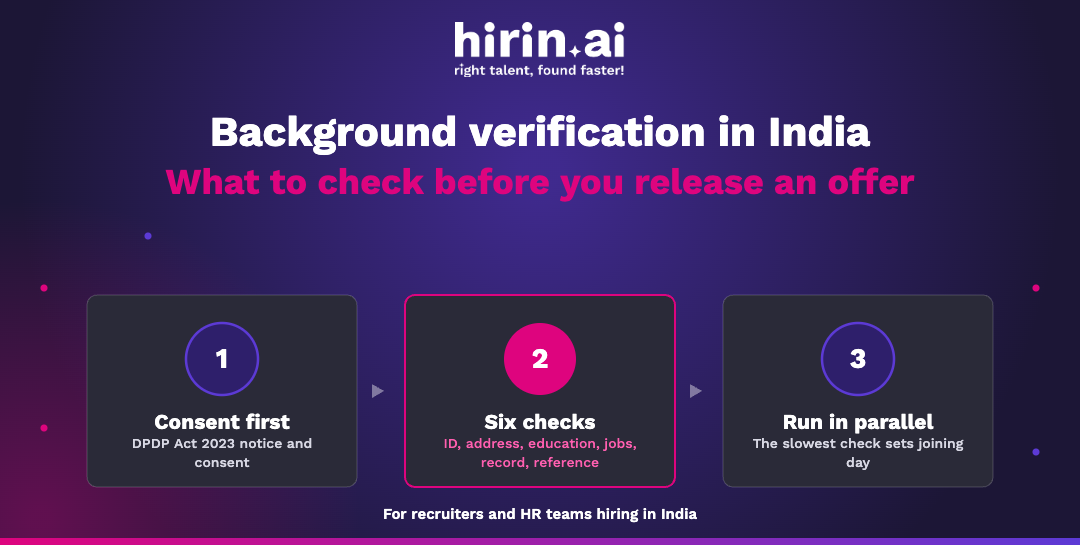
- Consent comes first. Under the DPDP Act 2023, consent must be free, specific, informed, unconditional and unambiguous, and the candidate can withdraw it.
- Match the depth of the check to the role. A full package for every hire costs more and slows joining for no gain.
- Run checks in parallel. In our illustrative example, six checks take 30 days one after another but 10 days together.
- The offer letter should say the offer depends on a satisfactory check, and what happens if it is not.
- On Aadhaar, offline verification with consent is the safer route. Take legal advice on anything beyond that.
Why does background verification for employment matter before the offer goes out?
Background verification for employment is the step where you confirm that what a candidate told you is true: who they are, where they live, what they studied, where they worked and whether they have a criminal record. The cheapest time to plan it is before the offer, because that is when you decide what you will check, ask for consent and set the expectation. If you wait until the candidate has resigned, you are checking under pressure, with a notice period running.
This guide is for recruiters, HR heads and agency owners who run the process. If your applicant tracking system talks to a verification partner, a lot of the chasing disappears, and the recruitment software integrations page lists which partners Hirin.ai connects to. We cover consent, each check, turnaround, the offer letter clause and the limits. It is a practical guide, not legal advice.
It also links to the money. A candidate who fails a check after resigning from a job is one more offer that never turns into a joining, and that is the number our offer to joining ratio guide tells you to watch. Verification done late is one of the quiet reasons the ratio slips.
What do you need from the candidate before you check anything?
You need their consent, and you need to tell them what you are doing. The Digital Personal Data Protection Act, 2023 says consent must be "free, specific, informed, unconditional and unambiguous with a clear affirmative action", and limited to the personal data necessary for the specified purpose (section 6(1)). A request for consent must be accompanied or preceded by a notice telling the person what data you will process and why (section 5(1)). The candidate can also withdraw consent at any time, and the Act says withdrawing should be as easy as giving it (section 6(4)).
Section 7 of the Act lists "legitimate uses" where consent is not needed, and clause (i) covers processing "for the purposes of employment or those related to safeguarding the employer from loss or liability". That wording is written around employees. Whether it covers a candidate who has not joined yet is a question for your lawyer. Our advice is simple: do not rely on it, and ask for consent in any case. It is also the practice that a verification partner will expect from you.
In practice, a good consent request has these parts:
- A separate request. Do not bury it inside the offer letter or the application form.
- A list of the checks. Name each one (identity, address, education, employment, criminal, reference) so the candidate knows the scope.
- Who will see the data. Name your verification partner and say your team sees the result, not more than it needs.
- How long you keep it. Say when it will be deleted. Section 8(7) expects erasure once the purpose is no longer being served, unless a law requires you to keep it.
- How to withdraw. A named person or email, and a plain statement of what happens to the offer if consent is withdrawn.
For the wider picture of what the Act asks of recruiters, read our recruitment compliance guide.
What should you check, and what can you check it against?
Six checks cover most hires in India. Which ones you run depends on the role. A cashier handling money and a data analyst with access to client files need different depth from a back office trainee.
| Check | What it confirms | Typical source | Watch out for |
|---|---|---|---|
| Identity | The person is who they say they are | Government ID, matched to a photo or a live check | Do not ask for more ID than you need. See the Aadhaar section below |
| Address | Current and permanent address | Digital address check, utility bill, or a field visit by the partner | Candidates who have just moved, and students in hostels |
| Education | Degree or certificate is real and matches the claim | University or board, or the National Academic Depository where the institution is on it | Slow when an institution answers by post. Foreign degrees take longer |
| Employment | Past employers, dates, designation, reason for leaving | Employer HR, relieving letter, payslips, EPFO passbook | Closed companies, informal employers, and gaps in service |
| Criminal record | No disqualifying history | Police verification or court record search | Name matches. Many people share a name, so confirm the match with the candidate |
| Reference | How past managers describe the work | A call to a named manager, not the candidate's friend | Only a signal. It is opinion, not a record |
Education: what does the National Academic Depository offer?
The National Academic Depository is a 24 hour online store where academic institutions publish their awards, so that a verifier can confirm them. Its own site says digital awards are legally valid under the IT Act, 2000. Its verifier page says a verifier registers on the API Setu portal, gets consent from the individual online or offline, and enters details such as roll number and year of passing. The response depends on whether that award is on the depository, so a miss does not mean the degree is fake. It means you go back to the institution.
Employment: what about the EPFO passbook?
Employees with a Universal Account Number can log in to the EPFO member portal and, as its own page says, download or print an updated passbook at any time. For a candidate who has been on the books of a PF registered employer, that passbook is a useful second document next to the relieving letter, because it shows which establishments contributed and in which months. Ask the candidate to share it. We have not verified what an employer can see of a member's history on its own, so do not assume you can look it up without the candidate.
Criminal record: police verification or court records?
These are two different routes. Police verification goes through the police authority for the candidate's address and can be slow. A court record search looks up the candidate's name and address against available court databases and is quicker, but it only covers what is searchable. Ask your partner which sources they use, which districts they cover and how they confirm that a hit is the same person. Keep the result proportionate. A traffic matter is not the same as fraud, and the role decides what is relevant. Write your policy down before the first adverse result arrives, not after.
What can an employer do with Aadhaar?
This is where recruiters get into trouble, so we are careful. What we can say from the primary source: UIDAI describes Aadhaar Paperless Offline eKYC as a way of verifying identity where the Aadhaar number is not revealed and only a reference ID is shared, and says any agency working with people can use it with the consent of the Aadhaar number holder (UIDAI page).
What we could not confirm from UIDAI's pages is the exact rule on when a private employer may use Aadhaar authentication, or how long it may hold an Aadhaar number. So we do not state one. Treat these as the safe working rules and then take legal advice:
- Do not make Aadhaar your sole accepted ID. Accept other government photo ID as well.
- Prefer offline verification with consent over copying and storing the number.
- Do not circulate full Aadhaar copies over WhatsApp groups or shared drives. If you must keep a copy, mask the number and limit who can open it.
- Let your verification partner handle it if they are authorised to, and ask them in writing how they are authorised.
DigiLocker, the government's document platform, describes itself as a secure cloud based platform for storage, sharing and verification of documents and certificates. A candidate who shares a document from their own DigiLocker, with their consent, gives you the document at its source. That is usually a better route than a photocopy on WhatsApp.
When should verification start, and how long does it take?
Start when the candidate accepts the offer in principle and gives consent, not after they have resigned. Run the checks together, because each one waits on a different party: a university, a previous employer, the police. The slowest check sets your date. Turnaround varies a lot by partner, city and employer, so ask your partner for their own figures by check type rather than trusting a brochure.
Worked example: 40 offers a month, one after another or together?
These numbers are illustrative assumptions, not Hirin data and not any vendor's price or service level. Swap in the figures your own partner quotes.
| Check | Turnaround (working days, illustrative) | Cost per candidate (hypothetical ₹) |
|---|---|---|
| Identity | 1 | 150 |
| Address | 5 | 400 |
| Education | 7 | 500 |
| Employment | 5 | 600 |
| Criminal record | 10 | 800 |
| Reference | 2 | 250 |
| Total if run one after another | 30 | 2,700 |
| If run together (slowest check) | 10 | 2,700 |
Take a candidate with a 30 day notice period. Run one after another, the checks use up all 30 days, so any delay pushes joining past the notice period. Run together, they finish in about 10 days and leave 20 days of cushion. At the hypothetical ₹2,700 a candidate, 40 offers a month cost ₹1,08,000 for a full package (40 × ₹2,700). That is a cost figure for verification only. The saving from running checks together is time, not rupees, because the package price is the same either way.
A tiered approach saves actual money. If, say, 30 of the 40 hires are junior roles where only identity, address and one employment check are needed (₹150 + ₹400 + ₹600 = ₹1,150 on the same hypothetical rates), the monthly bill becomes 30 × ₹1,150 + 10 × ₹2,700 = ₹34,500 + ₹27,000 = ₹61,500. That is ₹46,500 a month lower than a full package for everyone (₹1,08,000 minus ₹61,500), still illustrative. Whether the lighter check is right for those roles is your risk call.
Connect verification to the hire
See which background verification partners Hirin.ai connects to and how the report returns to the candidate profile.
On that page, Hirin.ai lists AuthBridge, IDfy, SpringVerify, OnGrid, First Advantage, HireRight and DigiLocker as verification connections available on request. It says verification starts when the offer is accepted, only with the candidate's consent, and the report comes back to the profile. Hirin.ai does not run the checks itself. A person on your team still decides what a result means for the offer.
What should the offer letter say about verification?
Make the offer conditional, and say so plainly. A vague line like "subject to company policies" will not help you if a check fails. Ask your lawyer to settle the wording, but cover these points:
- The condition. The offer depends on a satisfactory background verification, and the candidate's consent to it.
- The scope. The checks you will run, as listed in the consent request.
- The timing. Whether verification can finish after the joining date and, if so, what happens to the employment if a check later fails. Be honest with candidates about this, since it affects whether they resign.
- Misrepresentation. That false or misleading information can lead to the offer being withdrawn or employment ended.
- A fair chance to explain. If a result looks adverse, the candidate gets to respond before a decision, because many mismatches turn out to be name spellings or old records.
When does this not apply?
- Roles where a full package is not proportionate. For casual, short term or very high volume roles, a lighter check may be the right call. Decide by role, and write it down.
- Regulated sectors. Banks, insurers and some other regulated employers may have their own rules on what must be checked. Follow your regulator's rules, which may be stricter than this guide.
- Candidates abroad or with foreign degrees. Sources, timelines and consent rules differ. Ask your partner.
- First time workers. Freshers have no employment history. Lean on education, identity and address.
- Legal questions. This guide describes how the sources describe themselves and sets out good practice. It does not replace advice on Aadhaar, the DPDP Act or sector rules.
How do you measure whether your verification process works?
- Track days from consent to a clear report, by check type and by partner. The slowest check is where to push.
- Track the share of offers that reach joining after verification, and separate drop outs caused by a failed check from ones caused by a counter offer or a notice period dispute. Our offer to joining ratio guide shows how.
- Count discrepancies by type. If most are education mismatches, tighten that step. If most are name spellings, fix your data capture.
- Review adverse results monthly with a second person, so that decisions are consistent and a person, not a rule, makes the final call.
- Check data handling. Confirm that old reports are deleted on the schedule you promised in the consent request. The checklist in our recruitment software integrations checklist helps you ask the right questions of any partner.
Frequently asked questions
Is background verification mandatory in India?
Can I ask a candidate for their Aadhaar card?
Do I need consent for a background check under the DPDP Act?
When should I start verification: before or after the offer?
Does Hirin.ai do background checks?
How we researched this
We read the Act and the government pages directly. Quotes are from those pages as opened in November 2026. We could not open the Aadhaar Act, the UIDAI regulations on private entities or an EPFO page on employer access, so we make no claim on those points and recommend legal advice. The worked example uses stated, illustrative assumptions, not vendor prices or Hirin data. Hirin.ai integration details are as listed on its own integrations page.
- Ministry of Electronics and IT, Digital Personal Data Protection Act, 2023, sections 5, 6, 7 and 8.
- UIDAI, About Aadhaar Paperless Offline eKYC.
- EPFO, Unified Member Portal.
- National Academic Depository, Verifier process.
- DigiLocker, digilocker.gov.in.
- Hirin.ai, Recruitment software integrations.

Vikas Agarwal
Vikas Agarwal is the founder of Hirin.ai, an AI recruitment platform that screens, interviews and shortlists candidates for Indian hiring teams and staffing agencies. He has spent years building digital products and now works on the hiring problems recruiters raise every day. He writes about AI in recruitment, staffing and the future of work.