

On this page
- What is candidate ghosting?
- Where in the hiring process do candidates ghost?
- Why do candidates ghost recruiters?
- How do recruiters stop candidate ghosting?
- What should you do when a candidate ghosts you?
- Do recruiters ghost candidates too?
- How does AI recruitment software help with ghosting?
- What mistakes make ghosting worse?
- What does fewer ghosts look like in numbers?
- When does this not apply?
- How do you measure ghosting?
- Frequently asked questions
- How we researched this
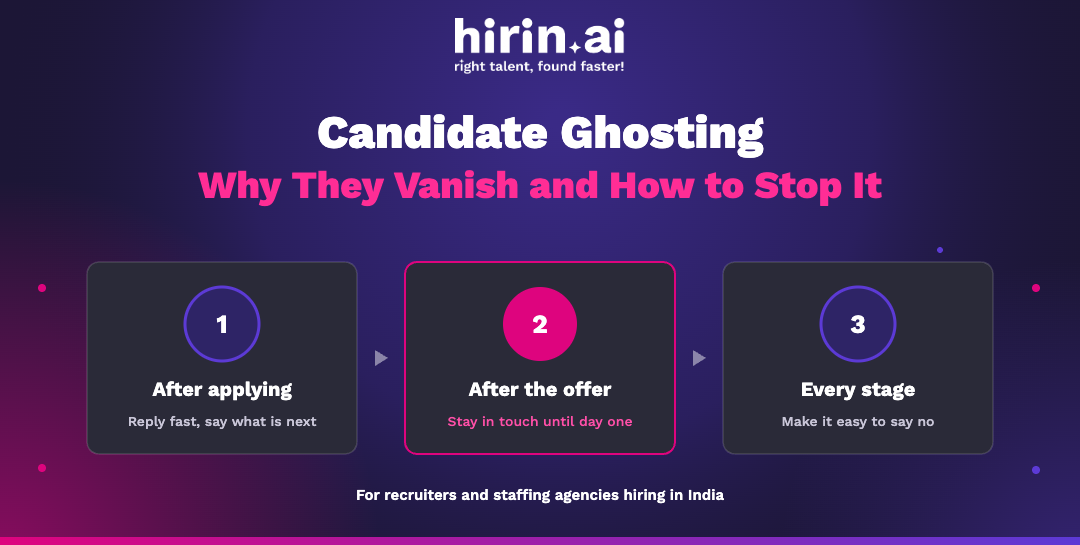
- Ghosting happens at every stage: after applying, after screening, after the offer and before joining. Fix each gap, not just the interview slot.
- Most reasons are about speed, clarity and awkwardness, which a recruiter can change. A better offer elsewhere is the part you cannot.
- In India, WhatsApp is the channel candidates actually read. Notice periods and offer shopping make the weeks before joining the riskiest stretch.
- Make it easier to say no than to vanish, and keep warm contact until day one.
- Track where candidates go quiet. You cannot fix a stage you have not measured.
What is candidate ghosting?
Candidate ghosting is when a candidate stops responding without saying why. They apply and go silent. They skip a call. They accept an offer and never sign. Or they say they will join and do not turn up on day one. The recruiter is left guessing whether the person is busy, lost interest or took another job.
It is not new, but it is easier now because applying takes one tap and candidates talk to several employers at once. The best defence is a process that answers quickly and keeps the conversation on the channel candidates already use. A recruitment chatbot on WhatsApp is one way to do that without adding hours to the recruiter's day, and we come back to it below.
This post covers the whole funnel. If your problem is specifically candidates missing booked interviews, our guide to reducing interview no shows goes deeper on that one stage.
Where in the hiring process do candidates ghost?
Everywhere. Indeed's 2019 Ghosting Guide surveyed over 4,000 candidates and nearly 900 employers in the US. Among the candidates, 18% said they had ghosted an employer, and among employers, 83% said they had been ghosted. The table shows the stages, for those who had ghosted and for the employers who had been ghosted.
| Stage (Indeed 2019, US) | Ghosters who did it | Ghosted employers who saw it |
|---|---|---|
| Skipped a scheduled interview | 50% | 84% |
| Stopped replying to calls and emails | 46% | 64% |
| Accepted a verbal offer, then vanished | 19% | Nearly 60% |
| Accepted an offer, missed the first day | 22% | 65% |
These are survey answers from 2019, from the US, and they say "has ever done it", not "how often". Treat them as proof that the problem spans the funnel, not as a benchmark for your pipeline.
Why do candidates ghost recruiters?
In the same Indeed survey, ghosters gave reasons you can sort into two piles: things you cannot control, and things you can.
| Reason given by ghosters (Indeed 2019) | Share | Can a recruiter change it? |
|---|---|---|
| Decided the job was not right for them | Over 50% | Partly: share real role details early |
| Received another offer | 40% | Partly: be faster, stay in touch |
| Not comfortable telling the employer | 26% | Yes: make declining easy |
| Salary not enough | 22% | Yes: state the range early |
| Benefits not enough | 15% | Yes: say what is on offer |
| Communication problems with the recruiter | 13% | Yes |
| Did not know what to do | 11% | Yes: give a clear next step |
Speed shows up too. Among ghosters aged 18 to 34, 27% said the hiring process was too slow or too long, against 18% of those aged 45 to 65 (Indeed, 2019, US).
What is different in India?
The Indeed data is not from India, so here we are describing patterns recruiters will recognise, not quoting figures. Three stand out.
- Notice periods. A candidate who accepts today may not join for 30, 60 or 90 days. That is a long time for a competing offer or a counter offer from the current employer to arrive.
- Offer shopping. Candidates hold several offers at once and join whoever stays in touch and moves fastest. The silence you see before joining is often a decision made somewhere else.
- The wrong channel. Candidates for frontline and volume roles are often easier to reach on WhatsApp than on email. A mail that sits unread can look like ghosting from both sides.
How do recruiters stop candidate ghosting?
Eight practices, in the order a candidate meets them. None is clever. Most are about not leaving a gap.
- Reply fast, and say when you will reply next. "We will update you by Thursday evening" beats a fast reply with no next step. Candidates who know when to expect news wait. Candidates who do not, look elsewhere.
- Share real role details early. Pay range, shift, location, notice period you can work with, and what the role is. The 22% who cited salary in the Indeed survey are best removed before a slot is booked, not after.
- Contact candidates on the channel they use. In India that is usually WhatsApp. Our guide to WhatsApp recruitment covers how to run it well.
- Set expectations for the whole process. Tell candidates the rounds, the rough timeline and who they will speak to. A process that feels long is the one candidates leave.
- Reconfirm before every scheduled step. Ask for a reply the day before an interview, a medical or a document check. A reply is an early warning. Silence is a flag you can act on while there is still time.
- Make it easy to say no. Offer a one tap reply such as "Reply 2 if this no longer suits you". Given that 26% of Indeed's ghosters were uncomfortable telling the employer, a polite exit removes the main reason to hide.
- Keep warm contact between stages. Between offer and joining, send something useful: the reporting address, the manager's name, what to bring, a welcome note. Contact does not mean pressure. It means the candidate remembers you.
- Close the loop on rejections. A short message to people you will not progress protects your name and your future talent pool. Someone who got a respectful no will answer next time.
One note on messaging. Sending WhatsApp messages means handling personal data, so get consent first, tell candidates what you will message about and let them opt out easily. India's Digital Personal Data Protection Act, 2023 is built around consent and notice. Ask your legal adviser what applies to your process before you scale messaging.
What should you do when a candidate ghosts you?
- Check you did not cause it. Was the last message from your side? How long ago? Silence after your slow reply is not ghosting yet.
- Follow up on the same channel, then once on another. Try WhatsApp, then a call. Keep the tone friendly, not accusing.
- Give an easy way out. "If you have taken another role, no problem. A quick reply lets us close this." Many candidates answer that.
- Set a stopping point. After two or three attempts over a few days, close the record and note the stage and likely reason.
- Keep a backup. For roles with high drop off, keep a ranked second choice warm until the first day.
- Do not blacklist on the first miss. People get ill, change phones and change their minds. Note it. Review before barring anyone.
Do recruiters ghost candidates too?
Yes, and candidates remember it. The most common version is not malice. It is a recruiter with 300 unread messages who cannot reply to everyone. The effect on the candidate is the same: they applied, nobody answered, and they take the other offer.
That matters because ghosting is partly a reply to how candidates are treated. In Indeed's survey, some ghosters said they felt misled by a recruiter or put off by the employer's attitude. If your own side goes quiet after screening or after an interview, expect the same in return. Closing the loop with every candidate, including the ones you reject, is the cheapest fix on this list. Our post on candidate trust in AI recruiters covers how to keep that trust when part of the contact is automated.
How does AI recruitment software help with ghosting?
Software cannot make a candidate want the job. It can remove the gaps that cause avoidable silence. Based on what the recruitment chatbot does on Hirin.ai, here is what it covers and what it leaves to people.
| Gap that causes ghosting | What the chatbot does | What stays with the recruiter |
|---|---|---|
| Slow first reply, especially at night | Answers candidate questions on WhatsApp and your careers site in seconds, any hour | Writing the role details it answers from |
| Vague role details | Answers salary range, shifts, location and next steps from your role details, in English, Hindi and Hinglish | Deciding what to share |
| Waiting for a first screen | Runs a short screen in chat on notice period, CTC, location and your role questions | Every decision. Nobody is rejected by the bot. When an answer does not fit, a recruiter decides and the candidate is told a person will reply |
| Interview scheduling back and forth | Offers slots, books the interview and sends a reminder the evening before | The interview itself |
| Candidate goes cold after a no | Messages past applicants when a new role fits them | Choosing which roles to open |
Candidates who would rather talk can take an AI voice screening call instead, and automated interview scheduling handles booking and rebooking on WhatsApp. For the "re engage" part, a well kept talent pool means someone who ghosted one role is not lost for the next.
For one reported result: GrowExx, Hirin's parent company, reports twice the applications processed, 75% fewer recruiter hours and 70% faster time to fill after adopting Hirin's hiring workflow (customer reported, measured across the whole workflow, not ghosting alone).
What mistakes make ghosting worse?
- Chasing too hard. Five messages in a day reads as pressure and raises opt outs. Two or three attempts, spaced out, is plenty.
- Hiding the pay. Salary mismatches are found out eventually. Better before the interview than after the offer.
- Going quiet after the offer. The weeks between acceptance and day one are when a counter offer arrives. Silence from you leaves room for it.
- Email only. If your only reminder is an email, you may be ghosting yourself.
- Treating every silence the same. Someone who replied twice and went quiet is not the same as someone who never answered.
- Messaging without consent. Adding candidates to WhatsApp lists without telling them what for creates complaints and blocks.
What does fewer ghosts look like in numbers?
Illustrative example. The figures below are assumptions, not Hirin customer data and not a benchmark. Use your own rates. Say you need 20 people to join. The only thing that changes is the share of accepted offers that actually turn up on day one.
| Assumption or result (illustrative) | Joining rate 75% | Joining rate 90% |
|---|---|---|
| People needed to join | 20 | 20 |
| Offers accepted needed (20 ÷ joining rate, rounded up) | 27 | 23 |
| Offer acceptance rate (assumed, same in both) | 80% | 80% |
| Offers to release (accepted ÷ 80%, rounded up) | 34 | 29 |
In this example, lifting the joining rate from 75% to 90% means 5 fewer offers to release, 4 fewer acceptances to chase and the same 20 joiners. That is recruiter capacity, not cash saved. It becomes a saving only if it replaces overtime, a contractor or a planned hire. Our post on the offer to joining ratio shows how to measure your own.
Reply to every candidate, any hour
The recruitment chatbot answers questions on WhatsApp and your careers site, runs a short screen in chat, books the interview and sends a reminder the evening before.
When does this not apply?
Faster replies cannot rescue a role the candidate no longer wants. If pay, shift timings or location are the problem, more messages only raise opt outs. A better offer will still win some candidates, and a counter offer from a current employer is outside your control.
The survey figures here are from 2019 and from the US. They show where ghosting can happen, not how often it happens in India or in your sector. Some silence is also not ghosting at all: illness, a lost phone, a family matter. And if the delay sits with a hiring manager who takes two weeks to give feedback, the fix is that manager's deadline, not a reminder to the candidate.
How do you measure ghosting?
Count the silence at each stage, not one overall number.
- Reply rate after application: how many candidates answer your first message, and how long it took you to send it.
- Show rate by stage: screening call, interview, document check, day one.
- Offer acceptance and joining rate: kept separate, by role and by notice period.
- Time from last contact to silence: where is the gap that most often precedes a ghost?
- Recovered candidates: how many came back after a follow up, and how many of those went on to join.
Change one thing at a time, such as adding a WhatsApp confirmation, and compare comparable roles over the same weeks.
Frequently asked questions
Why do candidates ghost after accepting an offer?
Is candidate ghosting illegal?
Should I blacklist candidates who ghost?
Does WhatsApp reduce ghosting?
Does Hirin.ai reject candidates who go quiet?
How we researched this
The practices come from how recruiters handle each stage of the funnel and from what the Hirin.ai recruitment chatbot page describes. The joining rate table is an illustrative example with stated assumptions. Survey figures were read on the publisher's own page on 15 November 2026. They are from 2019 and from the US, so treat them as direction, not an Indian benchmark. We could not open the text of the Digital Personal Data Protection Act, 2023 on a primary government site, so we describe it only in general terms and link no section.
- Indeed, The Ghosting Guide: An Inside Look at Why Job Seekers Disappear (published 26 August 2019 on Indeed's US site; survey of over 4,000 job seekers and nearly 900 employers across industries, the page does not name the country so we treat it as US; used for the stage figures, reasons and age split).

Vikas Agarwal
Vikas Agarwal is the founder of Hirin.ai, an AI recruitment platform that screens, interviews and shortlists candidates for Indian hiring teams and staffing agencies. He has spent years building digital products and now works on the hiring problems recruiters raise every day. He writes about AI in recruitment, staffing and the future of work.