

On this page
- What are pre screening questions?
- Where do pre screening questions sit: form, chatbot or phone?
- Which pre screening questions does every role need?
- What pre screening questions should you ask for each role?
- How do you word pre screening questions so they are fair and lawful?
- Knockout questions or scoring questions?
- What does structured screening save? A worked example
- When does this not apply?
- How do you measure whether your pre screening questions work?
- Frequently asked questions
- How we researched this
- Ask the same short set of questions of every applicant, in the same words, on a form, a WhatsApp chat or a call.
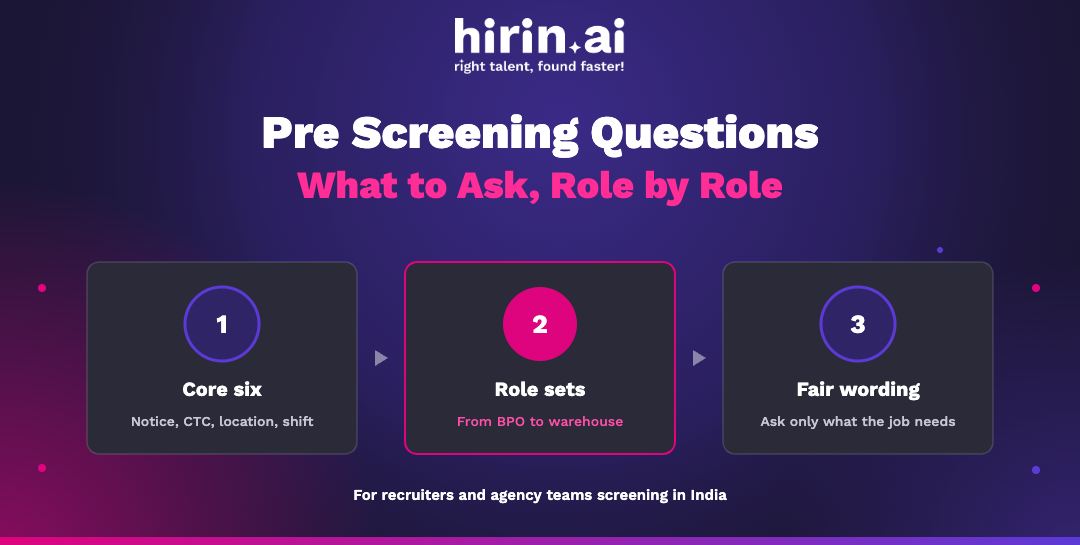
- Every role needs the core set: notice period, CTC, location, shift fit and joining date. Then add role questions that test real work.
- Ask only what the job needs. Leave out religion, caste, marital status, pregnancy and age unless a law requires it.
- Use knockouts sparingly and score the rest. Nobody should be rejected by a rule alone; a person makes the final call.
- Measure completion, pass rate and interview to offer, and read a weekly sample of screened out candidates.
What are pre screening questions?
Pre screening questions are the first questions an applicant answers, before any interview. They check the facts that decide whether a conversation is worth having: can this person join when you need them, at a salary you can offer, in a place and shift that works, with the basic skills the job needs.
Teams run them in three places, and the questions can be the same in all three. A form on the careers page or job post, a chat on WhatsApp, or a call. Tools for AI screening ask your questions on WhatsApp or an AI voice call and save each answer to the candidate profile. The rest of this guide covers what to ask and how to word it.
Still sorting CVs by hand before this step? Our guide on how to screen resumes covers that part.
Where do pre screening questions sit: form, chatbot or phone?
| Channel | Best for | Watch out for |
|---|---|---|
| Application form knockouts | Hard facts such as location, shift and a required licence | Long forms can lose people, especially on mobile |
| WhatsApp chat | Candidates who reply when free, including evenings; high volume roles | Answers can be short or unclear, so allow free text on key points |
| Phone or voice screen | Roles where speaking is part of the job; regional language candidates | Missed calls; a callback option or a chat fallback helps |
Many teams use two: a form with a few hard fact questions, then a chat or a call. Our posts on the recruitment chatbot and AI voice screening go deeper on each channel.
Which pre screening questions does every role need?
Six questions work for almost any role in India. Ask them in the same order every time, and write down the answer in the candidate's own words as well as a tick.
| Question | Why it matters | Better wording |
|---|---|---|
| Notice period | Decides how soon the seat is filled. Notice that can be bought out or shortened is worth knowing | "What is your notice period, and is any part of it negotiable with your employer?" |
| Current CTC | Helps you see whether the role is a step up and whether the offer is realistic | "What is your current annual CTC, fixed and variable separately?" |
| Expected CTC | Finds a mismatch early, before a client or hiring manager invests time | "What range are you looking for in this role?" |
| Location and relocation | Distance can decide whether someone stays in a field or branch role, so check it first | "Where do you live now? Are you able to work from the location listed?" |
| Shift fit | Night, rotational and split shifts can be a reason people leave | "This role runs on rotational shifts, including nights. Does that work for you?" |
| Availability to join, and work authorisation where relevant | A start date and, for roles that need a visa or a right to work, the status to take the role | "When could you start if selected?" and, only where needed, "Do you have the right to work in the country this role is based in?" |
Add three to five questions about the work itself. Ask for a fact or a short example, not an opinion. "How many years have you handled outbound calls?" tells you more than "Are you good at sales?".
What pre screening questions should you ask for each role?
Use the core six first, then these. They are examples to adapt, not a standard.
BPO and voice process
| Question | What you learn |
|---|---|
| Which languages can you speak fluently for work? | Match to the process language need |
| Have you worked a voice process before? Which one and for how long? | Relevant experience in a quick answer |
| Are you comfortable working night or rotational shifts, including weekends? | Shift fit, which affects early exits |
| Please describe a time you calmed an upset customer. Two or three lines is fine. | A free text answer a person can read quickly |
We cover this segment in more depth in our BPO recruitment guide.
Sales and field sales
| Question | What you learn |
|---|---|
| What did you sell, to whom, and what target did you handle? | Product, buyer and scale, in the candidate's words |
| Which territory or city did you cover? Can you cover the one listed? | Territory fit |
| How much of your last salary was fixed and how much was incentive? | Whether the incentive structure will suit them |
IT developer
| Question | What you learn |
|---|---|
| Which languages and frameworks have you used in production, and for how long? | Skills as years with evidence, not a tick list |
| Name your most recent project and your own part in it. | Ownership and recency |
| Are you open to the work mode for this role: office, hybrid or remote? | Work mode fit |
Pair this set with a short skill check; our guide to the skill assessment test shows how.
BFSI: collections and relationship managers
| Question | What you learn |
|---|---|
| Have you worked in collections, lending, insurance or wealth sales? Which product? | Product and segment experience |
| What was your portfolio size or target in your last role? | Scale of responsibility |
| Which branch area do you prefer, and which regional language do you use with customers? | Branch and language match |
| Do you hold any licence or certificate this role asks for, for example an insurance agent licence? | A factual check for roles that need one |
The AI screening page on the Hirin.ai site notes that regional language screening matters most in BFSI hiring for branch and field sales roles. Read our BFSI recruitment challenges post for the wider picture.
Retail store staff
| Question | What you learn |
|---|---|
| Have you worked on a shop floor or at a billing counter before? | Basic experience |
| Can you work on weekends, holidays and during sale seasons? | Availability for peak days |
| Which store location is closest to you, and how will you get there? | Commute and reliability |
Blue collar and warehouse
| Question | What you learn |
|---|---|
| What kind of work have you done: loading, packing, picking, machine operation? | Task fit |
| Are you comfortable with standing, lifting or physical work as set out in the job description? | Job requirement stated openly |
| Which shifts can you work, and can you work overtime when needed? | Shift and overtime fit |
| Are you currently working? When could you start? | Joining date |
Our blue collar recruitment guide covers sourcing for these roles.
How do you word pre screening questions so they are fair and lawful?
The rule of thumb is simple. If the answer does not change whether a person can do the job, do not ask. Some topics are risky to ask at the first screen and almost never needed:
- Religion, caste or community
- Marital status, plans for children, or pregnancy
- Age or date of birth, unless a law requires a minimum age for the task
- Disability or health conditions asked as a diagnosis
- Gender, or any question that assumes one
Instead, ask about the duties. For example, "This role involves standing for most of a shift. Are you able to do this, with or without adjustments?" That is about the work. A question about health history is not.
On gender, the Ministry of Labour and Employment's compliance handbook says the Code on Wages, 2019 bars discrimination on the basis of sex while recruiting employees (section 3). Other laws, for example on disability, may also apply to your questions, and we have not covered them here. This is general information, not legal advice. Ask your legal adviser to check your question list before you roll it out.
The Digital Personal Data Protection Act, 2023 applies to the answers you collect. Section 4 allows processing for a lawful purpose with consent or for certain legitimate uses. Section 6 says consent must be free, specific, informed, unconditional and unambiguous, given by a clear affirmative action, for the specified purpose, and limited to the personal data necessary for that purpose. Section 1 says the Act comes into force on dates the Central Government notifies, so ask your adviser which provisions apply to you today.
In plain terms: tell candidates why you are asking, ask only what you need, and do not reuse answers for something unrelated. Your legal adviser should confirm your consent notice.
Knockout questions or scoring questions?
A knockout question has a clear yes or no that matches a fact of the job, such as "Can you work from this city?" or "Do you hold the licence the role requires?". A scoring question is one where the answer has degrees, such as years of experience, expected CTC against the budget, or a short answer on handling an upset customer.
| Knockout | Scoring | |
|---|---|---|
| Use for | Hard facts of the job | Fit that comes in degrees |
| Example | Valid licence for a driving role | Years of voice process experience |
| Risk | Wrong rule shuts out good people | Weights can drift away from the job |
| Safeguard | Keep to three or four, review often | Show the reasons behind each score |
Nobody should be rejected by a rule alone. A rule can flag a mismatch, sort a list or hold a candidate for review, and a person on the team makes the final call. Candidates below your bar should be kept in your talent pool with the reason noted, since a role that does not fit today may fit next month.
The Hirin.ai product pages say the same: the AI asks and scores, the recruiter decides, and candidates below the bar are not deleted.
What does structured screening save? A worked example
Illustrative example. The numbers below are assumptions for one role with 300 applicants. They are not Hirin.ai results, and they do not include software cost. Change them to match your team.
| Assumption (illustrative) | Manual phone screening | Structured first round |
|---|---|---|
| Applicants | 300 | 300 |
| Recruiter time per applicant | 8 minutes, with dialling, retries, the call and notes | 2 minutes to read the saved answers |
| Applicants who finish the first round | All 300 are called, but some never answer | 240 (80%, assumed) |
| Review of screened out sample | Not done | 30 applicants, 2 minutes each |
| Follow up calls to the top candidates | Included in the 8 minutes | 40 calls, 8 minutes each |
| Setup of question set | None | Done once per role, not counted here |
Manual: 300 × 8 minutes is 2,400 minutes, which is 40 hours (illustrative).
Structured: 240 × 2 minutes is 480, plus 30 × 2 minutes is 60, plus 40 × 8 minutes is 320. That is 860 minutes, or about 14 hours (illustrative).
The difference is about 26 hours of recruiter capacity for this one role (illustrative). That is time freed, not money saved. It becomes a cost saving only if it replaces overtime, a contractor, an agency fee or a planned hire. It also has to be set against the software cost, which this example leaves out.
Ask the same questions of every applicant
Hirin.ai reads every CV, then asks your pre screening questions on WhatsApp or an AI voice call and saves each answer to the candidate profile. Your recruiters review a ranked shortlist.
When does this not apply?
- Very low volume. If a role gets a handful of applicants, a short call from a recruiter may be quicker than building a question set.
- Senior and leadership hiring. A conversation about scope and fit matters more than a fixed list. Use the core six, then talk.
- Legal advice. This guide is not legal advice. Your question list should be checked by someone qualified for your state and sector.
How do you measure whether your pre screening questions work?
Review a few measures weekly, comparing like with like, such as the same role before and after a change.
| Measure | How to read it |
|---|---|
| Completion rate | Share of applicants who finish the first round. A low rate means the questions are too long, the channel is wrong, or the timing is poor |
| Pass rate | Share who move to a recruiter. Very high means the bar is loose; very low may mean a knockout is shutting out good people |
| Interview to offer | Share of interviewed candidates who get an offer. If it falls, the screen is letting through the wrong people |
| Weekly sample of screened out candidates | A person reads a small sample of people who did not pass, and checks whether any should have gone through |
The last one matters most, because a rule that looks fine on a dashboard can shut out good people. If your sample finds one, change the question.
Frequently asked questions
How many pre screening questions should I ask?
Is it fine to ask for current CTC?
Can a chatbot or an AI call do the pre screening?
Should I reject candidates who fail a knockout question?
How we researched this
We wrote the question sets from common first screen practice for each role and marked them as examples, not a standard. We read the Hirin.ai product pages for every product claim, and the Digital Personal Data Protection Act, 2023 for the data points. The worked example is illustrative. Checked 15 November 2026. We did not open the texts of the disability or gender identity laws, so the post does not describe them. This is general information, not legal advice.
- Ministry of Electronics and Information Technology, The Digital Personal Data Protection Act, 2023 (No. 22 of 2023) (2023; sections 1, 4 and 6 on commencement, lawful purpose and consent).
- Ministry of Labour and Employment, Compliance Handbook for Employers Under the Four Labour Codes (2026; Code on Wages, section 3, no sex discrimination in recruitment).
- Hirin.ai, AI screening product page (page last updated October 2026; what the product asks and who decides).
- Hirin.ai, AI voice screening product page (page last updated October 2026; AI voice calls, saved answers and who decides).

Vikas Agarwal
Vikas Agarwal is the founder of Hirin.ai, an AI recruitment platform that screens, interviews and shortlists candidates for Indian hiring teams and staffing agencies. He has spent years building digital products and now works on the hiring problems recruiters raise every day. He writes about AI in recruitment, staffing and the future of work.