

On this page
- When is a walk in drive the right tool?
- How do you plan a drive back from the joining date?
- How many people do you need to invite for 100 joiners?
- How do you design the stations and staff the day?
- Why pre register candidates and send WhatsApp reminders?
- How do same day offers, no shows and the waitlist work?
- What costs should you budget?
- What safety, privacy and fairness rules apply?
- What does the run sheet for the day look like?
- What happens after the drive?
- When does this not apply?
- How do you measure it?
- Frequently asked questions
- How we researched this
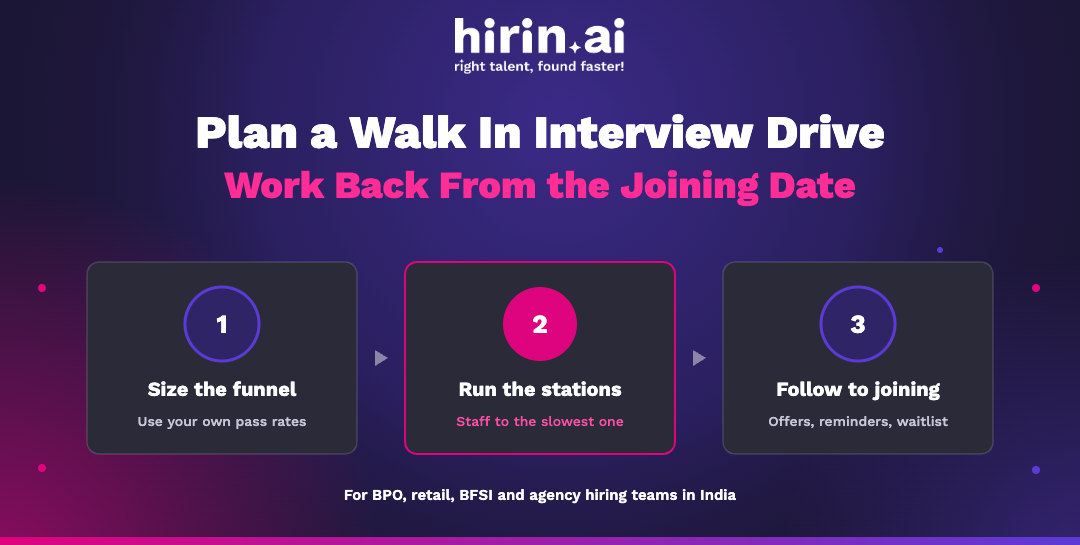
- Plan from the joining date backwards. The date decides when offers go out, which decides when the drive must happen.
- Size the crowd from your own pass rates at each stage, not from a benchmark. The example below is illustrative.
- The slowest station sets how many people you can finish in a day, and so how many staff you need.
- Pre registration and WhatsApp reminders matter more than the venue. Show up rate is the first number to protect.
- Never take money from candidates, and tell them what data you collect and why before you collect it.
A walk in drive is a one day logistics project with a funnel behind it. Most of the pain comes from a wrongly sized funnel or queues nobody planned for. This is the playbook for HR and TA leads told to deliver 100 joiners from one event.
If you hire for a contact centre or back office, our page on BPO recruitment shows the wider picture. For the full volume hiring strategy, read the bulk hiring guide. This post covers the day itself and the weeks around it.
When is a walk in drive the right tool?
A drive suits many people for the same role by a fixed date, when candidates can reach one place. It is the wrong tool when the need is steady, spread over many locations, or for a skill that takes more than an hour to judge.
| Situation | Drive fits | Continuous hiring fits |
|---|---|---|
| Client ramp or new process with a fixed go live date | Yes, one batch, one date | Only as a top up |
| Steady attrition cover, a few seats a week | Rarely worth a day | Yes |
| Many small branches, or roles needing a long technical round | No, or one drive per cluster | Yes |
How do you plan a drive back from the joining date?
Start with the date training or the first shift begins, then subtract the time each step needs. Use the gaps your own batches show.
- Fix the joining date and the notice reality. Freshers can join quickly. Experienced candidates often serve notice. If half your pool has notice periods, hold the drive earlier or move the joining date.
- Set the offer date and the drive date. Same day offers shorten the gap. If offers need approval, add that time. Pick a weekday when your candidates are free and avoid local holidays, exams and festivals.
- Set the registration window. Open it early enough to fill the day and close it early enough to send reminders and plan staff. Start ads, referrals and talent pool outreach only once the date and venue are confirmed.
- Book a second date. If you are short on the day, a follow up drive or phone round a week later saves the ramp.
How many people do you need to invite for 100 joiners?
Work from the end of the funnel to the start. Take the share who pass each stage in your own recent drives and divide. With no history, run a small pilot and use its numbers.
Illustrative example. The rates are made up to show the maths. They are not benchmarks.
| Step (illustrative) | Rate, assumed | People needed |
|---|---|---|
| Joined on day one | Target | 100 |
| Offers made | 70% of offers join | 143 |
| HR rounds held | 60% of HR rounds end in an offer | 238 |
| Assessed | 50% of those assessed go to the HR round | 476 |
| Attend on the day | 80% of attendees go to the assessment | 595 |
| Pre registered | 60% of those pre registered attend | 992 |
Check it from the top: 992 pre registered at 60% is 595 attending. At 80% that is 476 assessed. At 50% that is 238 HR rounds. At 60% that is 143 offers. At 70% that is 100 joiners. Rounded up, you need about 1,000 pre registered candidates (illustrative).
Two cautions. The 70% at the offer stage is the number most teams get wrong, because joining depends on notice, shift, commute and rival offers. Our post on the offer to joining ratio shows how to measure yours. And a funnel this wide may not fit in one day, so split it across two rather than squeezing the stations.
How do you design the stations and staff the day?
Run the drive as a production line of five stations, with candidates moving one way. You need a waiting area big enough for the busiest hour, separate rooms or screened zones for assessment and HR rounds, and signs in the languages your candidates read.
- Registration. Check the pre registration code or QR, confirm identity, give a token number. Walk ins join the same list here.
- Screening. A short check on role fit, shift, location, notice period and documents. A person decides who goes on, and gives a clear reason to anyone who does not.
- Assessment. Typing, a written task, a listening test or a short role play, depending on the role. Our post on the skill assessment test covers what to test and how to score it.
- HR round. A structured interview with the same questions and scorecard for every candidate.
- Offer and documents. The offer, the document checklist and joining instructions in one place.
Estimate how many candidates one person or room can finish in an hour, then divide the people you expect by the hours they arrive.
Illustrative example. Arrivals spread over six hours, and the times per candidate are guesses to replace with timings from a pilot.
| Station (illustrative) | People | Time each | Capacity per hour | Needed per hour | Staff |
|---|---|---|---|---|---|
| Registration | 595 | 1.5 minutes | 40 per desk | about 99 | 3 desks |
| Screening | 595 | 3 minutes | 20 per screener | about 99 | 5 screeners |
| Assessment | 476 | 40 minutes per batch of 20, with changeover | 30 per room | about 79 | 3 rooms |
| HR round | 238 | 15 minutes | 4 per interviewer | about 40 | 10 interviewers |
| Offer and documents | 143 | 10 minutes | 6 per desk | about 24 | 4 desks |
The stations need 3 + 5 + 3 + 10 + 4 = 25 people, with one invigilator per assessment room. Add 4 floor coordinators for queues and complaints, and 1 drive lead who owns the run sheet. The total is about 30 people (illustrative).
Why pre register candidates and send WhatsApp reminders?
Pre registration gives you a list, a headcount for staffing, and a way to reach people before the day. A simple form or WhatsApp link is enough. Ask for name, phone number, role, shift preference, location and notice period, and nothing you will not use.
Reminders are the cheapest way to lift show up rates. Send a confirmation straight away, a reminder two days before, a message the evening before with the venue pin, time slot and documents to bring, and a short one on the morning. Give each candidate a time slot so arrivals spread out. Our post on reducing interview no shows goes deeper.
You can also screen before the drive. Hirin.ai reaches applicants on WhatsApp and runs AI voice screens in English, Hindi and 22+ Indian languages, so your team can see who fits and invite them to the site. A person on your team makes every decision, and nobody is rejected by a rule. That can cut the crowd and the staff you need on the day.
Screen before the drive, not at the gate
Hirin.ai reaches applicants on WhatsApp, runs AI voice screens, checks typing, shift and commute, and keeps each batch on track until training starts.
How do same day offers, no shows and the waitlist work?
Candidates decide fast, and a week's delay loses many to other offers. Same day offers work when the approver is on site, the template is ready and the pay band is agreed before the drive.
- Confirm shift, location and joining date out loud and note the answer. Night shifts and long commutes are common reasons for dropouts after the offer.
- Give a written document checklist and say which items can follow after joining. Record acceptance by signature or a WhatsApp reply, with the time.
- No shows. Message them that evening and offer a second slot. Chase once or twice, no more.
- Waitlist. If more people are suitable than seats, rank them and tell them honestly they are waitlisted. When someone declines or does not join, the next person gets the offer.
- Unregistered walk ins. Decide beforehand: end of the queue, or the next drive.
Offers and joining documents can go out on WhatsApp through offer management, which saves the desk from typing the same message 143 times (illustrative).
What costs should you budget?
We do not quote market rates, because venue and advertising prices vary too much by city and season. Fill these headings with real quotes: venue (hall, power, internet, security), advertising and outreach, staff time, assessment tools, and comfort and travel.
Staff time is capacity, not a saving. It turns into cash only if it replaces overtime, a contractor or a planned hire. Divide the full cost by the number who actually joined, not the number who attended. Our post on cost per hire shows which lines to count.
What safety, privacy and fairness rules apply?
Candidate data under the DPDP Act, 2023
Under the Digital Personal Data Protection Act, 2023, a request for consent must be accompanied or preceded by a notice saying what data you want and why (section 5(1)). Consent must be free, specific, informed, unconditional and unambiguous, and limited to the data necessary for the stated purpose (section 6(1)). It also expects reasonable security safeguards (section 8(5)) and erasure once the purpose is served (section 8(7)).
In practice: put a short notice on the form and at the desk, collect only what the next step needs, lock paper forms away, and agree how long you keep data of people not hired. The Act comes into force provision by provision on dates the Government notifies, so ask your counsel what applies today. This is general information, not legal advice.
Never collect deposits
Do not take money from candidates, whether it is called a registration fee, security deposit, uniform charge or training fee. It damages trust and exposes your client to complaints. Put "No fee is charged at any stage" on every poster and message.
Night shifts and women candidates
The conditions for women working at night differ by state and sit in each state's Shops and Establishments Act and rules. We did not open an official state text for this post, so we do not list them. Ask your legal team to confirm them for the state of work, and tell candidates about shift and transport before the offer, not after. Use one scorecard for everyone. For physical and shift roles generally, see our post on blue collar recruitment.
What does the run sheet for the day look like?
Give a printed copy to the drive lead and each station head. Move the timings to suit your venue.
| Time (illustrative) | What happens | Owner |
|---|---|---|
| 7:30 am | Venue open, signs up, stations set, laptops and printers tested | Drive lead |
| 9:00 am | Interviewer briefing done, registration opens, screening and first assessment batch start | Registration head |
| 12:00 pm | First offers issued, waitlist started, staff lunch in shifts | Offer desk head |
| 2:00 pm | Queue review, move people to the slowest station; registration closes at 3:00 pm | Drive lead |
| 4:30 pm | Last assessment batch done, last HR rounds and offers | Station heads |
| 5:30 pm | Debrief: counts per stage, waitlist ranked, data locked away | Drive lead |
| Evening | WhatsApp to everyone: offered, waitlisted or not selected, with next steps | TA coordinator |
What happens after the drive?
The drive is the middle of the project. Most of the 100 joiners are won or lost between the offer and the first day.
- Same evening. Tell every candidate where they stand. Silence loses good people.
- Within a few days. Collect documents and acceptances, call anyone who has not replied, and move to the waitlist when someone drops.
- First weeks. Check in with the batch and call the same morning when someone misses a day or goes quiet.
When does this not apply?
The maths works for entry level roles where one test and one interview are enough. It does not fit senior hires, long technical rounds, or candidates spread across the country. It also assumes your pass rates are stable. For a new process, city or client, your history may not apply, so run a small pilot first.
How do you measure it?
Count people at each station and compare with your plan. Keep these numbers for the next drive.
| Measure | How to calculate it |
|---|---|
| Show up rate | Attended divided by pre registered. Sets how many to invite next time. |
| Pass rate per stage | Passed divided by entered, per station. Replaces the assumptions in your funnel. |
| Queue time per station | Average wait from token time to start. Shows the bottleneck. |
| Offer to joining | Joined divided by offers made. The number your plan depends on most. |
| Early retention | Still in role at the end of the first month. |
Frequently asked questions
How many people should I invite for 100 hires?
Is one day enough for 100 hires?
Can we charge candidates a registration fee?
Do we need consent to collect candidate details at a drive?
How we researched this
The funnel, station and run sheet numbers are illustrative maths, built to show the method, and are not benchmarks. The legal points come from the Act text itself. We did not verify state night shift rules or a statutory fee ban from a primary text, so we do not state them as law. Checked 15 November 2026.
- Government of India, Ministry of Electronics and Information Technology, The Digital Personal Data Protection Act, 2023 (2023; sections 5, 6 and 8 for notice, consent, safeguards and erasure).
- Hirin.ai, BPO and KPO recruitment software (product page, read November 2026; for what Hirin.ai does on WhatsApp, voice screening, reminders and offers).

Vikas Agarwal
Vikas Agarwal is the founder of Hirin.ai, an AI recruitment platform that screens, interviews and shortlists candidates for Indian hiring teams and staffing agencies. He has spent years building digital products and now works on the hiring problems recruiters raise every day. He writes about AI in recruitment, staffing and the future of work.