

On this page
- What is an AI interview?
- What are the types of AI interview, and which fits which role?
- Why can an AI interview give a fairer first round?
- What should an AI interview score, and what should it never score?
- What does India's DPDP Act mean for AI interviews?
- Worked example: when does an AI interview pay back for an agency?
- When is an AI interview the wrong choice?
- How do you measure whether AI interviews are working?
- Frequently asked questions
- How we researched this
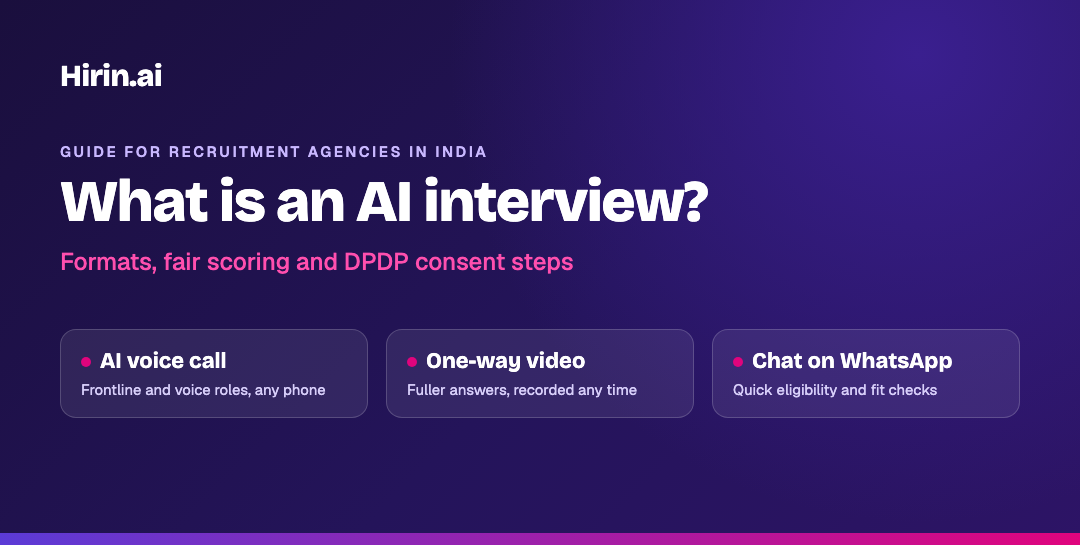
- There are three common formats: an AI voice call, a one-way video and a text chat. Pick by role and by how candidates will actually take it, usually on a phone.
- An AI interview is a structured interview: same questions, same rubric, every time. That consistency is where most of its value comes from.
- Score what was said against the role. Never score accent, face, background or tone.
- India's DPDP Act asks for a clear notice and consent, and lets candidates read the notice in English or any Eighth Schedule language.
- Whether it pays back depends on total monthly volume, minutes saved and software cost. The worked example below shows a drive where it does and one where it does not.
What is an AI interview?
An AI interview replaces the repetitive first round, the call where a recruiter asks the same ten questions about notice period, current and expected CTC, location, shifts and basic role fit. The software asks those questions, captures the answers, and hands the recruiter a transcript, a summary and a score with the evidence behind it. The recruiter decides who moves on.
Most search results on this topic are written for candidates preparing for one, or for large employers in the US. This guide is for the other side of the table: recruitment and staffing agencies in India, and small businesses hiring in volume, deciding whether and how to run AI interviews on their own mandates.
It is already common. In TestGorilla's 2025 survey of 1,084 people involved in hiring in the US and UK, 20% of employers said they use AI to interview candidates (outside research, US and UK, not India; source).
What are the types of AI interview, and which fits which role?
| Format | How it works | Best for | What the candidate needs | Watch out for |
|---|---|---|---|---|
| AI voice call | An AI agent phones the candidate, says it is an AI, asks the questions and follows up on unclear answers | Voice process, BPO, sales, field and frontline roles where speaking is part of the job | Any phone, no app or data pack | Missed calls. Offer a callback and a WhatsApp follow up |
| One-way video | The candidate records answers to set questions on a phone or laptop, in their own time | Customer-facing, relationship manager, IT and graduate roles where you want to hear a fuller answer | A smartphone or laptop, a camera and some bandwidth | Drop-off on weak connections. Keep it short and allow prep time |
| Chat interview | The same questions sent as a chat, often on WhatsApp, answered by typing or tapping | Eligibility checks, shift and location fit, high-volume roles where the candidate is at work | A phone with WhatsApp | Says little about spoken communication. Pair it with a call for voice roles |
| Live interview with AI notes | A human interviews and the AI transcribes, summarises and maps answers to the rubric | Second rounds and senior roles | A normal call or video meeting | Saves note-taking, not interviewer time |
For most agencies the first round is a phone call today, so an AI voice interview is the closest swap. One-way AI video interviews earn their place one round later, when you want a hiring manager to hear how someone explains things. We compare the two video formats in live vs asynchronous video interviews, and the mechanics of scoring in how AI video interviews work.
Why can an AI interview give a fairer first round?
Because it is a structured interview by design. Every candidate hears the same questions in the same order and is scored on the same rubric. A large 2022 re-analysis of selection research by Sackett, Zhang, Berry and Lievens found structured interviews to be the top-ranked selection procedure for predicting job performance (outside research on interviews in general, not on AI tools or Hirin; source). A recruiter on their fortieth call of the day, by contrast, asks different follow ups and notes different things.
There is now field evidence on AI voice interviews too. In an experiment by Jabarian and Henkel with 70,000 applicants for real jobs, applicants were randomly assigned to a human recruiter or an AI voice agent for the interview, and human recruiters then made the hiring decisions. Applicants interviewed by the AI agent were 12% more likely to receive a job offer, a relative increase rather than 12 percentage points, and the gains carried through to job starts and retention (outside research, not a Hirin result; source). The authors put it down to interviews that were more consistent while still responding to each applicant.
What should an AI interview score, and what should it never score?
| Score it | Never score it |
|---|---|
| Facts the role depends on: notice period, CTC range, location, shift and travel fit | Accent, regional pronunciation or which language the candidate chose |
| Whether the answer covers the points in your rubric, with the quote that shows it | Face, expressions, eye contact or appearance |
| Role knowledge you would test in a human first round | Background noise, room, device or video quality |
| Spoken clarity, only for roles where speaking to customers is the job | Tone or "confidence" as a personality read |
| Completion and availability for the next round | Anything you could not defend to the candidate if they asked |
Write the rubric before you write the questions. If you cannot say what a good answer contains, neither the AI nor a recruiter can score it consistently. Our guide to interview questions that predict job fit has sample questions and rubric lines.
What does India's DPDP Act mean for AI interviews?
An AI interview collects personal data: voice recordings or video, transcripts, salary details and sometimes ID. Under the Digital Personal Data Protection Act, 2023, a request for consent must come with or after a notice that says what personal data you will process and why, how the candidate can exercise their rights, and how to complain to the Data Protection Board (section 5(1)). Consent has to be free, specific, informed, unconditional and unambiguous, given by a clear affirmative action (section 6(1)).
Two details matter for Indian agencies. First, section 5(3) gives candidates the option to read the notice in English or any language in the Eighth Schedule to the Constitution, so a Hindi or Tamil interview should come with a notice the candidate can read in that language. Second, the DPDP Rules notified in November 2025 give organisations an eighteen-month period for phased compliance and call for a separate consent notice that is clear and easy to understand (PIB note on the Rules). Use that window to set the process up, not to wait. This is a summary, not legal advice.
- Say it is an AI at the start of the call or chat, and that the interview is recorded.
- Send a short notice first: what you collect, why, who sees it (you and your client), how long you keep it, and how to ask for deletion.
- Ask for a clear yes before the first question, and offer a human round to anyone who declines.
- Keep the decision human. No candidate should be rejected by the AI alone.
- Set a retention period for recordings and transcripts, and delete on schedule.
Worked example: when does an AI interview pay back for an agency?
Take an agency running a first round for a voice support mandate with 200 applicants. Every figure below is an illustrative assumption, not Hirin customer data and not Hirin's pricing. Replace them with your own.
| Assumption (illustrative) | Value |
|---|---|
| Applicants who need a first-round interview | 200 |
| Recruiter minutes per manual first-round call, including redials and notes | 10 |
| Recruiter minutes per candidate to review an AI interview summary and score | 2 |
| One-time recruiter time to write questions and rubric | 2 hours |
| Loaded recruiter cost per hour | ₹400 |
| Software cost for this drive (hypothetical, not Hirin's pricing) | ₹6,000 |
| Result (illustrative) | Working | Value |
|---|---|---|
| Manual recruiter time | 200 × 10 min | 33.3 hours |
| Recruiter time with AI interviews | 200 × 2 min + 2 hours setup | 8.7 hours |
| Recruiter time freed | 33.3 − 8.7 | 24.7 hours |
| Value of recruiter time freed | 1,480 min ÷ 60 × ₹400 | ₹9,867 |
| Net, after software | ₹9,867 − ₹6,000 | ₹3,867 |
Read the ₹9,867 as the value of recruiter time freed, which is capacity, not cash. It becomes a budget saving only when those hours replace overtime, a freelancer, or a recruiter you would otherwise add, or when the same team takes on more mandates.
Break-even. Each candidate saves 8 recruiter minutes, worth 8 ÷ 60 × ₹400 = about ₹53. After the ₹800 of setup time, covering ₹6,000 of software needs about 128 candidates. The same drive with 60 applicants frees about ₹3,200 of time minus ₹800 of setup, against ₹6,000 of software: a loss of about ₹3,600 (illustrative). So judge it on your total monthly volume across mandates, not on one role.
Faster first rounds can also mean fewer candidates lost to other offers and earlier placements. That is a separate benefit. Measure it in your own funnel and report it next to the time saving, never added to it.
Hear an AI interview on your own role
Hirin.ai's AI voice agent calls each applicant, says it is an AI, asks your questions in English, Hindi or other Indian languages, and your recruiter decides.
When is an AI interview the wrong choice?
- Low volume. A handful of candidates a month rarely covers software and setup. Run the break-even sum first.
- Senior and niche roles. When there are five good people in the market, a scripted first round can feel like a brush-off. Have a person call them.
- Vague criteria. If the client cannot say what a good answer looks like, the scores will be noise and the hours come back as extra interviews.
- The wrong format for the candidate. A long video round for warehouse or delivery roles, or an English-only call for Hindi-speaking applicants, will mostly measure who gave up.
- Candidates who do not want it. In Pew Research's 2022 survey of 11,004 US adults, 71% opposed AI making the final hiring decision and 41% opposed AI reviewing job applications (outside research, US adults; source). Keep the decision human, say so, and offer a person to anyone who asks.
How do you measure whether AI interviews are working?
- Take a baseline of 4 weeks for one role family: applicants, recruiter hours on first rounds, time from application to first contact, and submissions to the client.
- Compare like with like. Run AI interviews on some comparable mandates while others stay manual over the same weeks, so the season and applicant mix do not skew the result.
- Track completion by format. If many candidates start but do not finish, shorten the interview or switch format before judging the scores.
- Check the scores against people. Each week, have a recruiter review a sample of candidates the AI scored low as well as high, and note where they disagree.
- Follow quality downstream: client interview-to-offer rate, offer acceptance, joining and 90-day retention. Recruitment analytics puts the funnel in one place.
Before you put a voice agent in front of candidates, our guide on how to test an AI voice agent for recruitment explains how to test one and which Indian rules apply.
Frequently asked questions
Is an AI interview legal in India?
Does the candidate know they are talking to an AI?
Can an AI interview be run in Hindi or regional languages?
Does the AI decide who gets hired?
How long should an AI first-round interview be?
How we researched this
We read the top search results for "ai interview" and found them written mainly for candidates or for US employers, so this guide takes the Indian agency's side. Product details come from Hirin.ai's own product pages as of October 2026. The worked example uses stated, illustrative assumptions, not Hirin platform data, and the software figure is hypothetical, not Hirin's pricing. Each outside figure was checked against the primary source below.
- Jabarian, B. and Henkel, L., Voice AI in Firms: A Natural Field Experiment on Automated Job Interviews, arXiv 2607.28222 (2026).
- Sackett, P. R., Zhang, C., Berry, C. M. and Lievens, F., Revisiting meta-analytic estimates of validity in personnel selection, Journal of Applied Psychology (2022).
- TestGorilla, The State of Skills-Based Hiring 2025, survey of 1,084 hiring decision makers in the US and UK, April 2025.
- Pew Research Center, AI in Hiring and Evaluating Workers: What Americans Think, survey of 11,004 US adults, December 2022.
- Ministry of Electronics and IT, Digital Personal Data Protection Act, 2023, sections 5 and 6.
- Press Information Bureau, note on the Digital Personal Data Protection Rules, 2025.

Vikas Agarwal
Vikas Agarwal is the founder of Hirin.ai, an AI recruitment platform that screens, interviews and shortlists candidates for Indian hiring teams and staffing agencies. He has spent years building digital products and now works on the hiring problems recruiters raise every day. He writes about AI in recruitment, staffing and the future of work.