

On this page
- What is bulk hiring?
- When do companies need bulk hiring?
- How does the bulk hiring process work?
- A worked example: how many applicants do you need?
- Where bulk hiring goes wrong, and how to fix it
- When bulk hiring is the wrong approach
- How to measure bulk hiring
- How Hirin.ai supports bulk hiring
- Frequently asked questions
- How we researched this
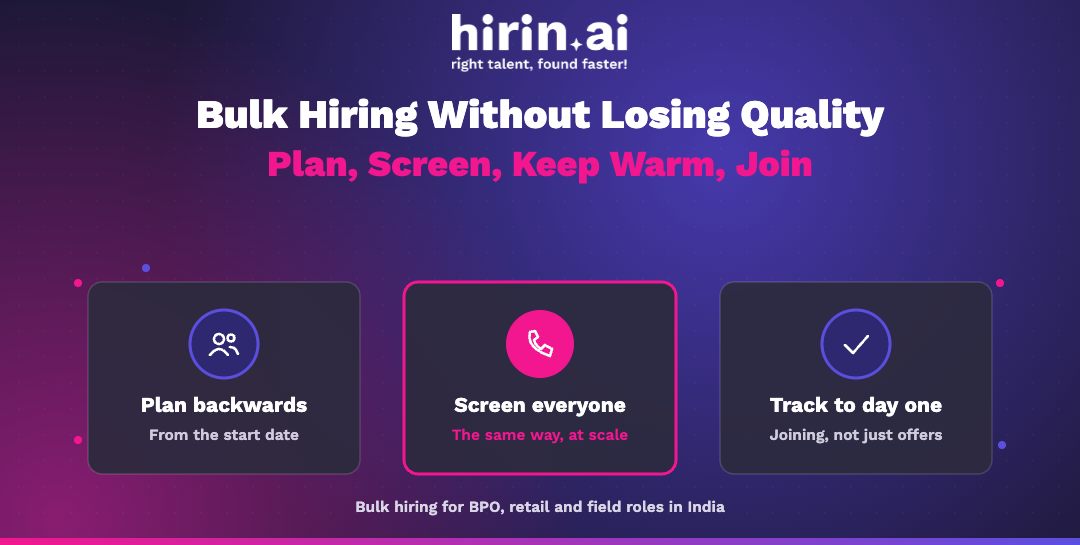
- Plan from the start date backwards, using your own past drop off at each stage.
- Screen every applicant the same way: language, shift, commute and salary first, skills second.
- Most bulk hiring losses happen after the offer, so keep in touch until day one.
- Measure joiners and 30 and 90 day retention, not offers sent.
A new client signs on the 1st. Training starts on the 20th, and the floor needs a full batch. The job boards are full of applicants, the phones are full of missed calls, and three recruiters are trying to screen a few hundred people by hand. That is what bulk hiring looks like from the inside, and most of it goes wrong in the same few places.
What is bulk hiring?
Bulk hiring, also called mass hiring or high volume hiring, is recruiting a large number of people for the same or similar roles in a short time. The roles are usually entry level or operational: customer support and voice process, back office, retail store staff, delivery and field sales, plant operators. Because the roles repeat, the hiring process can repeat too, and that is what makes bulk hiring manageable.
Demand for this kind of hiring is not slowing. Naukri JobSpeak reported that fresher hiring in BPO and ITES rose 48% year on year in February 2026 (outside research, based on Naukri job postings).
When do companies need bulk hiring?
- A BPO or contact centre ramping up for a new client or process.
- Retail and ecommerce teams staffing up before festive and sale seasons.
- A new plant, warehouse or site that needs a full shift at once.
- Banks, NBFCs and insurers building field sales and collections teams.
- Campus and fresher batches that join together.
How does the bulk hiring process work?
- Plan backwards from the start date. Fix the headcount and date, then use your own past numbers to work out how many applicants, screens and offers you need.
- Write one role profile. Agree the must haves with the hiring manager: language, shift, location, minimum skills and salary range.
- Open several channels at once. Job boards, referrals, WhatsApp, walk ins, campuses and local agencies.
- Screen everyone the same way. A short WhatsApp or voice screen on language, shift, commute, salary and joining date removes most mismatches in minutes.
- Test what the job needs. A listening test and short role play for voice roles, typing for back office, a practical task for plant roles.
- Batch interviews and offers. Run interview slots and offer rounds in groups so nobody waits a week for an answer.
- Keep candidates warm until day one. Send reminders, collect documents and check in through the notice period.
- Track to joining and beyond. Count who joins and who is still there at 30 and 90 days.
A worked example: how many applicants do you need?
Illustrative example with assumed rates, not Hirin data. Replace each rate with your own history.
| Stage | Assumed rate | People needed |
|---|---|---|
| People who must join | Target | 100 |
| Offers to make | 60% of offers join | 167 |
| Final interviews | 50% of interviews get an offer | 334 |
| Applicants who complete the screen | 40% pass the screen | 835 |
| Applicants to reach | 70% complete the screen | 1,193 |
The maths runs backwards: 100 joiners divided by 0.6 is 167 offers, divided by 0.5 is 334 interviews, divided by 0.4 is 835 screened, divided by 0.7 is about 1,193 applicants. Small changes at the end of the funnel move the top a lot. Lift the joining rate from 60% to 75% and you need about 240 fewer applicants (952 instead of 1,193) for the same 100 joiners.
Where bulk hiring goes wrong, and how to fix it
| Problem | Why it happens | Fix |
|---|---|---|
| Interview no shows | Long gaps between screen and interview | Book slots on the same call and send reminders |
| Offer dropouts | Silence during the notice period | Check in at resignation, relieving date and the week before joining |
| Inconsistent screening | Each recruiter asks different questions | One script and one scoring rubric for everyone |
| Recruiter bottleneck | Every applicant needs a phone call | Screen on WhatsApp or an AI call first, call only the people who pass |
| Early attrition | The job was not what they expected | Show shift, pay and the work honestly before the offer |
Fill your next batch on time
WhatsApp outreach, AI voice screens with a listening test and role play, and every batch tracked until training starts.
When bulk hiring is the wrong approach
Bulk processes suit roles that repeat. They fit badly for senior hires, specialist roles where each candidate is different, and small numbers where a recruiter can simply talk to everyone. Speed also has a cost: if you lower the bar to hit a date, early attrition usually wipes out the gain, so hold the must haves even when the batch is short.
How to measure bulk hiring
| Metric | How to calculate it | Why it matters |
|---|---|---|
| Joining rate | Joined divided by offers made | Shows how much you lose after the offer |
| 30 and 90 day retention | Still employed at day 30 and day 90, divided by joined | Tells you whether you hired the right people |
| Time to start | Days from approval to the batch starting | The number the business cares about |
| Drop off by stage | People lost at each funnel stage | Shows where to fix the process |
| Cost per hire | Internal plus external hiring costs, divided by hires | Use the cost per hire method so batches compare fairly |
Compare like with like: the same role, site and season. And sample a few rejected candidates every week to check the screen is not turning away people who would have done well.
How Hirin.ai supports bulk hiring
Hirin.ai reaches every applicant on WhatsApp, runs AI voice screens with a listening test and a short role play for voice roles, checks typing, shift and commute, and keeps every batch on track until training starts. Recruiters spend their calls on the candidates who passed, and a person on your team makes every hiring decision. For the screening step in detail, see how AI resume screening works, with a BPO example.
Volume roles are often blue collar. Our guide to blue collar vs white collar hiring explains how the process differs.
Frequently asked questions
What is bulk hiring?
What is the difference between bulk hiring and high volume hiring?
How do you reduce no shows in bulk hiring?
Which roles suit bulk hiring?
How do you measure bulk hiring success?
How we researched this
The process and metrics come from how Hirin.ai customers run volume hiring and from standard recruitment practice. The worked example uses stated, illustrative rates, not Hirin platform data. Market figures are outside research and are described as published.
- Naukri JobSpeak, February 2026, IT Hiring Shows Meaningful Recovery; White-Collar Market Posts 12% YoY Growth.
- SHRM, ANSI/SHRM 06001.2012 Cost-per-Hire Standard.

Vikas Agarwal
Vikas Agarwal is the founder of Hirin.ai, an AI recruitment platform that screens, interviews and shortlists candidates for Indian hiring teams and staffing agencies. He has spent years building digital products and now works on the hiring problems recruiters raise every day. He writes about AI in recruitment, staffing and the future of work.