

On this page
- What is an AI voice agent in recruitment?
- Which screening tasks should an AI voice agent handle?
- Which Indian rules apply when an AI agent calls applicants?
- How do you test an AI voice agent before it calls real candidates?
- What does research say about AI voice interviews?
- When is an AI voice agent the wrong choice?
- How do you measure an AI voice agent after go-live?
- Frequently asked questions
- How we researched this
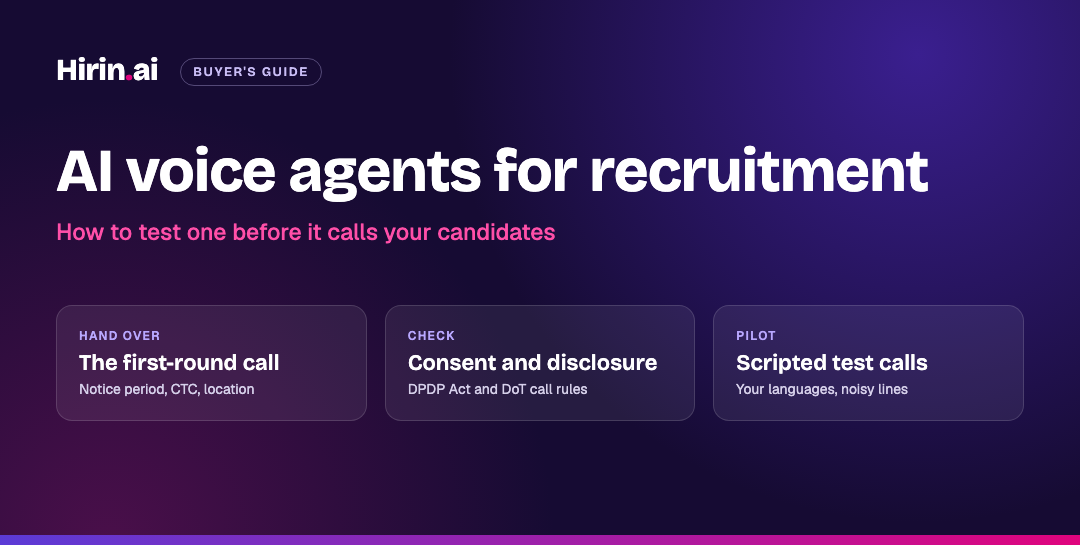
- Give the agent the repetitive first round: notice period, CTC, location, availability and a few role questions. Keep the hiring decision with a recruiter.
- Under the DPDP Act, 2023, the candidate needs a clear notice of what is collected and why, and consent that is specific and unambiguous. The notice can be in English or any Eighth Schedule language.
- Run a pilot of scripted test calls across your languages, accents and noisy lines before go-live, and set your pass mark before you listen, not after.
- Outside research is encouraging but narrow: one large field experiment found AI-run interviews raised job offers by 12% (relative), with humans still deciding.
What is an AI voice agent in recruitment?
Outside hiring, "AI voice agent" covers everything from support lines to sales callers. In recruitment it means one narrow job: a first-round phone screen. The agent calls an applicant (or answers when the applicant calls in), introduces itself as an AI assistant, asks a fixed set of questions, follows up when an answer is unclear, and saves a recording, transcript, summary and score on the candidate's profile. A recruiter then works from a ranked list instead of dialling every number.
If you want the mechanics of a call, from speech recognition to scoring, read our explainer on what AI voice screening is and how it works. This guide is for the step after that: deciding what to hand the agent, which Indian rules apply, and how to test one on your own roles before it speaks to a single real candidate. Voice is one step in a wider first round, which our guide to automated candidate screening maps out, and it is different from a full AI-led interview, covered in what an AI interview is.
Which screening tasks should an AI voice agent handle?
The rule of thumb for agencies and small hiring teams: give the agent questions that have a factual answer and are asked the same way to everyone. Keep anything that needs judgement about a person with a recruiter.
| Task on the first call | Give it to the agent? | Why |
|---|---|---|
| Notice period, current and expected CTC, location, relocation | Yes | Factual answers, asked the same way every time, and the main reason recruiters spend their day on the phone |
| Availability for interview slots | Yes | Simple to capture and easy to hand to automated interview scheduling |
| Must-have checks (a licence, a certification, years with a tool) | Yes | Clear yes or no answers you can define per role |
| Spoken language check for voice roles (BPO, inside sales) | Partly | The recording helps a recruiter judge, but the agent's score should be one input, not the verdict |
| Motivation, culture fit, "tell me about yourself" | Partly | The agent can ask and record; a recruiter should judge the answer |
| Rejecting a candidate | No | A recruiter should review anyone below the bar before they are turned down |
| Negotiating salary or making an offer | No | Needs judgement, authority and context the agent does not have |
| Anything about health, religion, caste, marital status or family plans | Never | Not relevant to the job and should not be asked by anyone |
Which Indian rules apply when an AI agent calls applicants?
Two sets of rules matter most: data protection, because the call collects personal data, and telecom rules on commercial calls, because the call is made by a business. This is a practical summary, not legal advice. Check your setup with your counsel and your telecom or calling provider.
The DPDP Act, 2023
| What the Act says | Where | What it means for a screening call |
|---|---|---|
| A request for consent must come with a notice of the personal data and the purpose | Section 5(1) | At application, tell candidates an AI agent may call them, what it will ask, that the call is recorded, and why |
| The notice can be read in English or any language in the Eighth Schedule | Section 5(3) | If you screen in Tamil or Marathi, offer the notice in that language too |
| Consent must be free, specific, informed, unconditional and unambiguous, with a clear affirmative action | Section 6(1) | A pre-ticked box is weak. Ask for a clear "yes, you can call me" at application |
| Erase data when consent is withdrawn or the purpose is no longer served, unless a law requires you to keep it | Section 8(7) | Set a retention period for recordings and transcripts, and make sure your vendor deletes them too |
| The person can ask for correction, completion, updating and erasure | Section 12 | Give candidates a way to ask, and a recruiter who owns the request |
Telecom rules on service calls
In May 2024 the Department of Telecommunications set aside a separate number series, starting 160, for service and transactional voice calls, so people can tell genuine calls apart from spam made from ordinary 10-digit numbers. The DoT release defines a service call as one made with the recipient's consent, or using a registered template, for a transaction the recipient has already agreed to. A promotional call is one made without explicit consent, and the 140 series is used for those.
For a recruiter, the practical points are simple. Get the candidate's consent to be called when they apply. Ask your calling provider which number series and registration your screening calls fall under. And avoid blasting applicants from random 10-digit numbers: the DoT itself notes that fraudsters use them, which is one reason candidates hang up on unknown calls.
How do you test an AI voice agent before it calls real candidates?
Vendor demos are recorded in quiet rooms with clear English. Your candidates call from a bus stop in Indore, switch between Hindi and English mid-sentence, and say "two months, but negotiable" when asked for notice period. A short pilot with scripted test calls shows how the agent handles your reality.
- Pick one live role with a high volume of applicants and write the five to eight questions the agent will ask.
- Write test scripts with known answers, including tricky ones: a range ("45 to 60 days"), a correction ("sorry, I meant 6 lakh, not 8"), an off-topic question back to the agent, and a candidate who asks to be called later.
- Have colleagues play the candidate in each language you hire in, on mobile phones, from a quiet room and from somewhere noisy.
- Set your pass mark before you listen. Decide in advance what counts as a correctly captured answer and how many misses you will accept per question.
- Compare the agent's transcript and score with the script, question by question, using the scorecard below.
- Fix the questions, not just the vendor. Many misses come from questions that are ambiguous when spoken. Reword, then rerun the calls that failed.
| Pilot check | How to test it | What to look for |
|---|---|---|
| AI disclosure | Listen to the first 15 seconds of every call | It says it is an AI assistant, that the call is recorded, and asks if now is a good time |
| Answer capture | Script answers with numbers, ranges and corrections | The saved answer matches what was said, including the correction |
| Language and code-switching | Mix Hindi and English, or your regional language, in one answer | Transcript stays accurate; agent does not restart or repeat the question needlessly |
| Noisy lines | Call from traffic, a shop floor or a weak signal | Agent asks again when unsure instead of guessing |
| Interruptions | Talk over the agent; ask "who is this?" mid-call | It stops, answers, and carries on from the right question |
| Callback and opt-out | Say "call me after 7" and, on another call, "don't call me again" | Callback is scheduled; opt-out is recorded and respected |
| Missed calls | Let a test call ring out | A follow-up goes out (for example, on WhatsApp) and the candidate can reply there |
| Scoring | Read the score and the reason for each test candidate | A recruiter would reach the same shortlist from the same answers |
| Data handling | Ask the vendor where recordings are stored and how deletion works | A written retention period and a deletion route that covers the vendor too |
Worked example: sizing a pilot (illustrative)
Here is how a recruitment agency hiring for a voice-process role in two languages might size its pilot. The numbers are an illustrative example, not a Hirin benchmark or a rule. Change them to fit your roles.
| Assumption (illustrative) | Value |
|---|---|
| Languages screened | 2 (Hindi and English) |
| Test scripts per language | 5 (clean, range, correction, interruption, callback request) |
| Line conditions per script | 2 (quiet room, noisy street) |
| Test calls in total | 2 × 5 × 2 = 20 |
| Recruiter time to review one call | About 6 minutes (listen, compare with the script, note misses) |
| Review time in total | 20 × 6 = 120 minutes, about 2 hours |
So in this illustrative example, about two recruiter hours of review tells you whether the agent captures your questions correctly before any candidate hears it. Add one more round of the same size for the calls that failed after you reword questions. If you hire in more languages, the call count grows with each language, so start with the two that cover most of your applicants.
Hear an AI voice agent screen for your role
Hirin.ai's voice screening agent says it is an AI, asks your questions in English, Hindi or 22+ Indian languages, and scores every answer for a recruiter to review.
What does research say about AI voice interviews?
The best evidence so far comes from a field experiment by Jabarian and Henkel with about 70,000 applicants for real jobs, randomly assigned to interviews run by human recruiters or by AI voice agents (study). Applicants interviewed by the AI agent were 12% more likely to receive a job offer. That is a relative increase, not 12 percentage points. The authors report that the gains carried through to job starts and retention, with no drop in the productivity of hired workers, and that human recruiters still evaluated the interviews and made the decisions. It is outside research, not a Hirin result, and one study in one hiring setting.
Candidates' comfort is the other side. In a Pew Research Center survey of 11,004 US adults in December 2022, 71% opposed employers using AI to make the final hiring decision, and 41% opposed AI reviewing job applications (Pew). That is outside research on US adults, not Indian applicants, but the direction is clear: people accept AI help in the process far more readily than AI deciding. That is one more reason to disclose the AI at the start of the call and keep a recruiter on the decision. Our guide on earning candidate trust in AI recruiters covers the rest.
When is an AI voice agent the wrong choice?
- Low volume, senior roles. If you get a handful of applicants for a leadership role, a recruiter call is the better first impression and the time saved is small.
- Candidates who did not apply. Cold-calling sourced profiles with an AI agent is a different situation from calling applicants who agreed to be called. Treat it with far more care, and check the consent and telecom rules above first.
- Questions that need judgement. If most of your first round is "why do you want to leave?", the agent can record answers, but a recruiter still has to listen to all of them.
- Languages you have not tested. Do not switch on a language for live candidates until it has passed your pilot.
- Candidates who prefer to type. Offer the same questions in chat. Hirin.ai's recruitment chatbot asks them on WhatsApp, and the answers land on the same profile.
How do you measure an AI voice agent after go-live?
- Take a baseline first. For four weeks before go-live, record applicants per role, recruiter hours on first-round calls, and days from application to first contact.
- Track the call funnel weekly: calls attempted, connected, completed, opted out, and callbacks requested.
- Audit a sample every week. A recruiter listens to a few completed calls and a few candidates below the bar, and checks the agent's answers and scores.
- Follow quality, not just speed: shortlist to interview, interview to offer, offer acceptance, joining and 90-day retention, compared with roles screened by recruiters over the same weeks.
- Count freed time as capacity. Recruiter hours freed become a cost saving only if they replace overtime, contractors or a planned hire. Net out the software and setup cost before you call it a saving.
Frequently asked questions
What is an AI voice agent for recruitment?
Do candidates have to be told they are speaking to an AI?
Can an AI voice agent screen in Hindi and regional languages?
Will an AI voice agent replace recruiters?
How long should a pilot take?
How we researched this
We read the Digital Personal Data Protection Act, 2023 and the Department of Telecommunications release on the 160 number series in full, and quote what they say rather than secondary summaries. Research figures come from the original study and survey pages, opened and checked on 24 Oct 2026. The pilot scorecard and worked example are Hirin.ai guidance with illustrative numbers, not platform averages or customer results. Product details describe Hirin.ai's voice screening page as of October 2026.
- Ministry of Electronics and IT, Digital Personal Data Protection Act, 2023, sections 5, 6, 8 and 12.
- Press Information Bureau, DoT allots separate numbering series exclusively for service and transactional voice calls, 30 May 2024.
- Jabarian, B. and Henkel, L., Voice AI in Firms: A Natural Field Experiment on Automated Job Interviews, arXiv 2607.28222.
- Pew Research Center, AI in Hiring and Evaluating Workers: What Americans Think, 20 April 2023.

Vikas Agarwal
Vikas Agarwal is the founder of Hirin.ai, an AI recruitment platform that screens, interviews and shortlists candidates for Indian hiring teams and staffing agencies. He has spent years building digital products and now works on the hiring problems recruiters raise every day. He writes about AI in recruitment, staffing and the future of work.