

On this page
- What does C2H mean?
- How is C2H different from C2C, contract staffing and permanent hiring?
- How does an agency make money on C2H?
- Who is the employer during the contract, and what compliance follows?
- What conversion clauses do agencies put in C2H contracts?
- How do you keep C2H candidates engaged until conversion?
- Illustrative example: agency margin over a 6 month contract, then conversion
- When does this not apply?
- How do you measure it?
- Frequently asked questions
- How we researched this
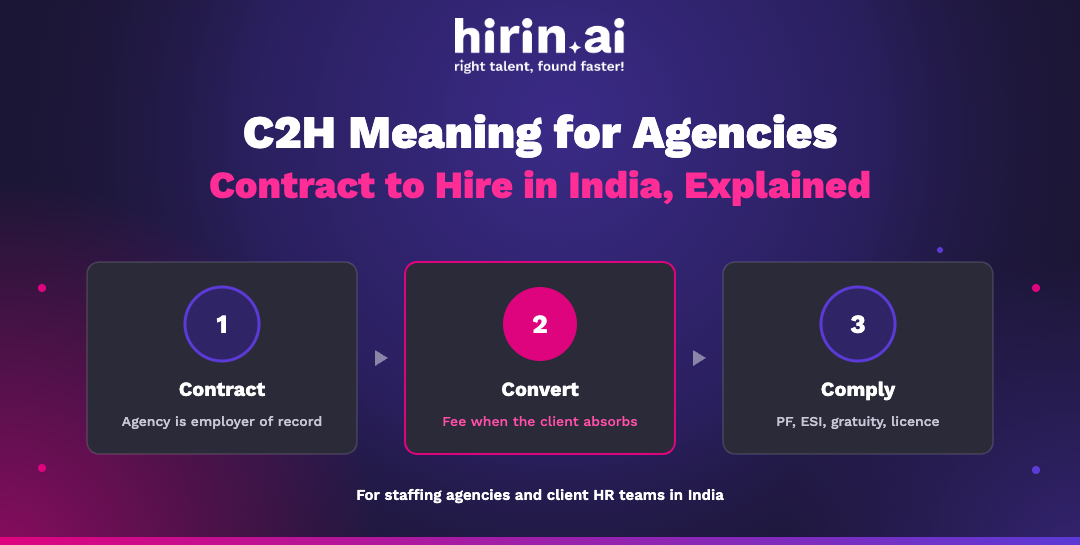
- In a C2H arrangement the agency is the employer of record during the contract. The client is the principal employer.
- Agency income comes in two parts: a markup on CTC while the contract runs, and a conversion fee if the client absorbs the person.
- Most of the margin is decided by the conversion clause: the conversion period, the fee basis and the non solicit terms. Write them before the contract starts.
- Under the Labour Codes, as the Labour Ministry describes them, gratuity for a fixed term employee starts after one year, so contract length matters. Check the current rules before you price.
- Candidates drift in the last month of a contract. Planned check ins protect the conversion fee.
What does C2H mean?
C2H stands for contract to hire. The candidate starts on a fixed term contract of an agreed length, for example six months, and the client has the right to convert them into a permanent employee at the end of it, or earlier. During the contract the person is on the payroll of a staffing agency, not the client's. Once converted, the person joins the client's own payroll.
For an agency, C2H sits between two familiar models: contract staffing, where you bill a markup for as long as the person stays, and permanent placement, where you earn a one time fee. If you run several clients at once, the mandates, contract end dates and conversion dates all need to be tracked somewhere reliable. Our page on recruitment agency software covers the mandate side, from sourcing to submission. The rest of this post covers the commercial and legal shape of C2H.
Some firms say temp to perm. This post is for agency owners, account managers and client HR teams.
How is C2H different from C2C, contract staffing and permanent hiring?
Ask two questions to separate them: whose payroll is the person on, and what happens when the contract ends.
| Model | Who employs the person | How the agency earns | What happens at the end |
|---|---|---|---|
| C2H (contract to hire) | The agency during the contract, then the client if converted | Markup on CTC during the contract, plus a conversion fee | Client converts the person, extends the contract or lets it end |
| C2C (corp to corp) | The person's own company, which invoices the agency or client | A margin on the rate the person's company charges | No conversion by default. The contract ends or is renewed |
| Contract staffing | The agency, for as long as the assignment lasts | Markup on CTC for the whole assignment | Assignment ends. Conversion only if the contract allows it |
| Permanent hiring | The client from day one | One time fee when the person joins | Not applicable. The person is a regular employee |
Our guide to IT staffing covers how contract and permanent roles mix on one desk, and the bench sales recruiter post covers placing a contractor from your bench.
How does an agency make money on C2H?
There are two income lines, and they behave differently.
Line one: the markup during the contract
The client pays the agency a monthly bill. The bill is the person's cost to the agency, usually the CTC plus the agency's statutory costs, with a markup on top. The markup is the agency's gross margin for the month. Out of it the agency pays payroll costs and carries the receivable, because salaries go out before the client pays.
Line two: the conversion fee
If the client takes the person onto its own payroll, the agency usually earns a conversion fee. It is commonly set as a percentage of the annual CTC the client offers, sometimes reduced by a credit for the markup already paid. There is no standard rate. You negotiate it and write it down. Our post on recruitment agency fee structures sets out how agencies usually price permanent placements.
In short, the markup pays for employment risk and payroll work. The conversion fee pays for the hiring work.
Who is the employer during the contract, and what compliance follows?
During a C2H contract the agency is the employer of record. It issues the appointment letter, runs payroll, deducts and deposits PF and ESI where they apply, and pays the person's dues. The client is the principal employer, and it still carries some duties for people working at its site.
Three points from the Ministry of Labour and Employment's own documents matter. Every worker is to get an appointment letter. If a contractor fails to pay wages in time or pays short, the principal employer is liable to pay the contract labour (compliance handbook). And the principal employer is to provide health and social security benefits to contract workers (press release). Details depend on the Rules, so read the current text.
| Item | What the Ministry or ESIC page says (as opened) | What to check for your C2H desk |
|---|---|---|
| Provident fund (PF) | The Code on Social Security applies the EPF chapter to establishments with 20 or more employees (Labour Ministry compliance handbook, 2026) | Whether the agency's own establishment is covered, and how PF is shown on the contract employee's payslip |
| ESI | The Code on Social Security applies the ESI chapter to establishments with 10 or more persons other than seasonal factories (Labour Ministry compliance handbook, 2026) | Whether the agency's establishment is covered, and whether each contract employee falls inside the wage ceiling the rules set. We did not verify that ceiling, so check it with ESIC |
| Gratuity | Fixed term employees become eligible for gratuity after one year of continuous service (PIB release, 21 November 2025; compliance handbook, 2026). The Ministry FAQs add that it is paid pro rata and applies from 21 November 2025 | Whether your contract length stays under or goes over one year, and how the agency provides for it |
| Contract labour licence | The OSH Code requires a contractor employing 50 or more contract workers to hold a licence, valid for five years. The Ministry handbook lists the Contract Labour (Regulation and Abolition) Act, 1970 among the laws the Code consolidates | Whether your headcount at a client site reaches the threshold, and whether your state has its own rules |
| Appointment letter | Mandatory for all workers, per the Ministry's release on the Labour Codes (21 November 2025) | A written letter that states the fixed term, the wages and the employer |
What is the status of the Labour Codes?
The Press Information Bureau release of 21 November 2025 says the four Labour Codes were made effective from that date, and that during the transition the relevant provisions of the existing Acts and their rules continue to remain in force. A Ministry FAQ published in 2026 repeats that old rules stay until new rules are finally notified. The compliance handbook still describes the new rules as draft rules. We could not confirm from a source we opened whether final rules are now in force in every state. Check the current notification for your state before you finalise a contract, and ask a lawyer which text applies. This is general information, not legal advice. Sources: PIB release, Ministry FAQs and compliance handbook.
For client HR teams: the Ministry FAQ says a principal employer may engage contract labour for core activities that are ordinarily carried out through a contractor, or for work of an intermittent nature or a sudden increase in volume needing time bound completion. A permanent, steady role dressed up as a contract is a different matter, worth a word with your adviser.
What conversion clauses do agencies put in C2H contracts?
There is no standard form, and the points below are described in general terms. Have a lawyer draft or review the actual clauses. Here is what agencies usually cover.
- Conversion period. The window in which the client may convert the person without a fee dispute, for example any time during the contract or within a stated number of months after it ends.
- Conversion fee. The basis (a share of annual CTC or a fixed sum), the amount, when it falls due and whether any markup already paid is credited against it.
- Minimum contract term. The shortest period before the client may convert, so the agency earns some markup before losing the person.
- Non solicit. A promise that the client will not hire the person directly, or through another vendor, without paying the fee. Some agencies ask for the same for a period after the contract ends.
- Early exit. What happens if the client ends the contract early, or the person leaves, and who bears the replacement.
How do you keep C2H candidates engaged until conversion?
A person on a contract can see the end date. In the last month some may start talking to other employers. If the person leaves before conversion, the agency loses the fee, so engagement is part of the commercial case.
- Set the conversion story on day one. Tell the person the client's intent, the review date and what conversion means for pay and role. Put it in writing so everyone remembers the same thing.
- Check in on a calendar. Short contact at the end of week one, month one, the midpoint and thirty days before the end, on whichever channel the person answers fastest, such as WhatsApp or a phone call. Slower replies or a request for a reference are signs of drift, so call that day.
- Keep a backup warm. If the person looks likely to leave, a second candidate for the same client should still be in conversation.
- Settle the paperwork early. Agree the offer letter and joining date with the client before the end date, so there is no gap in employment.
Hirin.ai does not run payroll, timesheets or invoicing, which stay in the tools you already use. It does search your own candidate database first for each mandate, so a backup is easier to find. For the wider picture, see our staffing agency software page.
Illustrative example: agency margin over a 6 month contract, then conversion
Illustrative example, not Hirin.ai pricing and not a market benchmark. Every figure below is an assumption. Replace each with your own contract terms and costs.
| Assumption (illustrative) | Value |
|---|---|
| Monthly CTC paid to the person | ₹60,000 |
| Markup on CTC, billed to the client | 15% (₹9,000 a month) |
| Agency payroll and compliance cost | 3% of CTC (₹1,800 a month) |
| Contract length | 6 months |
| Sourcing and screening cost for this hire | ₹15,000, one time |
| Client payment terms | 45 days, so about 1.5 months of billing is outstanding on average |
| Cost of funds | 12% a year on the outstanding amount, over 6 months |
| Conversion fee | 10% of the annual CTC the client offers, at the same ₹7,20,000, with no credit for markup |
| Line | Calculation | Result (illustrative) |
|---|---|---|
| Markup earned | ₹9,000 × 6 | ₹54,000 |
| Less payroll and compliance cost | ₹1,800 × 6 | ₹10,800 |
| Net contract margin | ₹54,000 minus ₹10,800 | ₹43,200 |
| Less sourcing cost | One time | ₹15,000 |
| Less cost of carrying receivables | Monthly bill ₹69,000 × 1.5 = ₹1,03,500; × 12% × 6/12 | ₹6,210 |
| Margin if the client does not convert | ₹43,200 minus ₹15,000 minus ₹6,210 | ₹21,990 |
| Conversion fee | 10% × ₹7,20,000 | ₹72,000 |
| Margin if the client converts | ₹21,990 + ₹72,000 | ₹93,990 |
In this illustration the contract on its own leaves about ₹21,990 after costs. The conversion fee is where most of the return comes from. The money arrives over about seven and a half months and only after the client pays, so cash flow matters more than in a permanent placement. The example ignores GST, income tax, any gratuity or leave provision, a person who leaves in month three, a late payer and a fee dispute. Each would reduce the result.
Fill your next C2H mandate
Hirin.ai searches your own database first, screens candidates on WhatsApp or an AI call, and drafts client ready submissions. Your recruiter reviews and sends. Payroll, timesheets and invoicing stay in your current tools.
When does this not apply?
- The role is steady and permanent. If the client knows it wants a permanent hire, a direct placement is cleaner than a contract. Ask your adviser before using C2H to defer a permanent commitment.
- The contract runs close to or beyond a year. The gratuity position changes at one year for a fixed term employee, so the cost model above no longer holds.
- The client will not agree conversion terms. Without a fee basis and a non solicit clause, the agency carries risk for no upside.
- You have no payroll capacity. Employer of record means payroll, filings and records. If you cannot run these, stay with permanent placement.
How do you measure it?
- Conversion rate. Of the contracts that reached their review date, how many converted. Track it by client, since clients differ.
- Time to conversion. Months from start date to conversion, per client and role family. It shows where the contract length is wrong.
- Margin per contract. Net contract margin plus any fee, after sourcing and the cost of carrying receivables. Show losses as negatives.
- Early exits. Contracts that ended before the review date, split by whether the client or the person ended them, and the reason.
Compare like with like: the same client and role family before and after any change.
Frequently asked questions
What is the full form of C2H?
Who pays the salary in a C2H arrangement?
Is gratuity payable on a C2H contract?
How is C2H different from C2C?
How we researched this
We read the PIB and Labour Ministry documents below on 15 November 2026. The worked example uses illustrative assumptions only, not Hirin.ai data or a benchmark. Claims about Hirin.ai come from the product page on recruitment agency software. This is general information, not legal advice. Have a lawyer review any C2H contract.
- Press Information Bureau, Ministry of Labour and Employment, Government Makes the Four Labour Codes effective to Simplify and Streamline Labour Laws (21 November 2025; effective date, appointment letters, fixed term gratuity, contract workers, transition).
- Ministry of Labour and Employment, FAQs on Labour Codes (2026; transition rules, gratuity effective date and pro rata basis, contract labour use).
- Ministry of Labour and Employment, Compliance Handbook for Employers Under the Four Labour Codes (2026; contract labour licence, principal employer liability, EPF and ESI applicability, gratuity).

Vikas Agarwal
Vikas Agarwal is the founder of Hirin.ai, an AI recruitment platform that screens, interviews and shortlists candidates for Indian hiring teams and staffing agencies. He has spent years building digital products and now works on the hiring problems recruiters raise every day. He writes about AI in recruitment, staffing and the future of work.