

On this page
- What is a bench sales recruiter?
- What does a bench sales recruiter do every day?
- Bench sales terms you will hear
- How the bench sales process works
- Bench sales vs IT recruitment
- What makes a good bench sales recruiter?
- How bench sales teams are measured
- When bench sales isn’t the right model
- Where software helps a bench sales desk
- Frequently asked questions
- How we researched this
- Bench sales is recruiting in reverse: you have the consultant, and you go and find the requirement.
- The work runs through a chain of vendors, implementation partners and end clients, usually on C2C or W2 terms.
- Every day on the bench is a day nobody is billing, so speed of submission decides most deals.
- Good desks are judged on placements and how much of the bench is billing, not on how many profiles they send.
Picture a Java developer whose contract with a bank ended on Friday. On Monday she is still on your payroll or still waiting on your call, and she is not billing anyone. Somebody has to get her in front of the next client this week, not next month. That somebody is the bench sales recruiter.
What is a bench sales recruiter?
A bench sales recruiter, sometimes called a bench sales executive or bench marketer, works for an IT staffing or consulting firm and sells its available consultants into new contracts. "Bench" means the pool of consultants who have finished one project and haven’t started the next. "Sales" is the honest word for it: the recruiter markets a person to buyers, negotiates a rate and closes the placement.
Most bench sales roles sit in US IT staffing, where consultants are placed through layers of vendors before they reach the company that actually needs the work done. A large share of those desks run from Indian cities like Hyderabad, Bengaluru and Noida, working US hours.
What does a bench sales recruiter do every day?
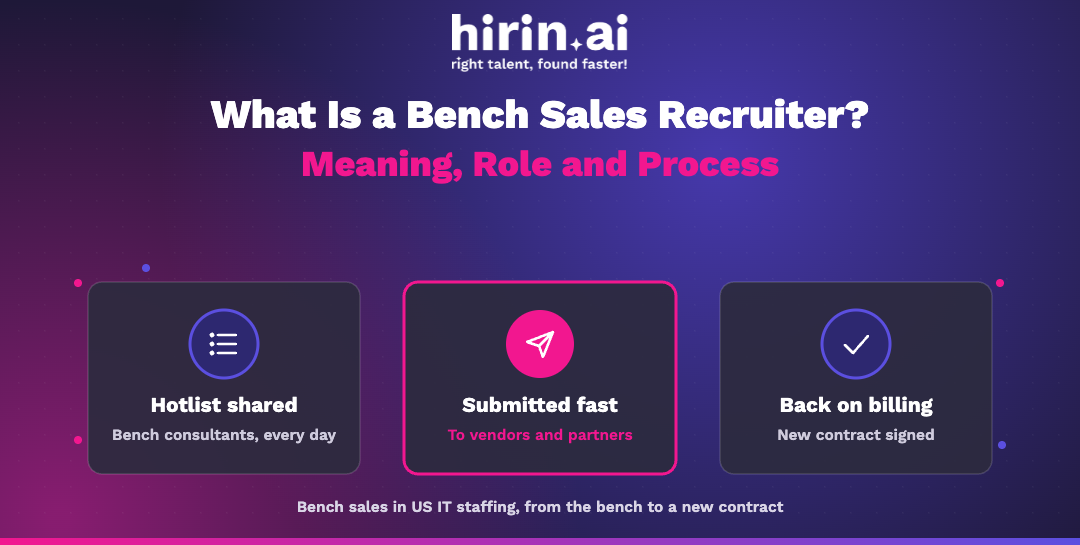
- Keeps the hotlist current. A hotlist is the list of consultants available right now, with skills, location, work authorisation and rate. It goes out to vendors every day or two.
- Finds requirements. Open contracts arrive from vendor emails and job boards such as Dice and LinkedIn, and through direct relationships with prime vendors.
- Submits consultants. Each submission goes out with a formatted resume, a short summary and the rate, and the recruiter confirms the consultant agrees to the role before it is sent.
- Negotiates the rate. On corp to corp deals the recruiter works out the rate with the vendor and protects the firm’s margin across each layer.
- Prepares and follows up. The recruiter preps the consultant for the client call, chases feedback and handles the paperwork once the offer comes in.
Bench sales terms you will hear
| Term | What it means |
|---|---|
| Bench | Consultants who are between projects and available for a new contract |
| Hotlist | The shared list of bench consultants, their skills, location and rate |
| C2C (corp to corp) | The consultant works through their own or their employer’s company and invoices the vendor, rather than being on the vendor’s payroll |
| W2 | The consultant is on the staffing firm’s payroll as an employee |
| C2H (contract to hire) | A contract that can turn into a full time role with the client |
| Prime vendor | A staffing company with a direct contract with the end client |
| Implementation partner | A consulting firm delivering the project for the end client, often hiring through vendors |
| End client | The company where the consultant actually does the work |
| Rate layers | The margin each company in the chain takes between the end client and the consultant |
How the bench sales process works
- A consultant rolls off a project and joins the bench. The recruiter updates their resume and confirms skills, availability, location preferences and expected rate.
- The consultant goes on the hotlist, which is shared with vendors and implementation partners.
- The recruiter searches open requirements and matches the consultant to the ones that fit.
- For each match, the recruiter gets the consultant’s go ahead and submits the profile with a rate.
- The vendor shortlists, and the recruiter preps the consultant for the client or vendor interview.
- On a selection, the recruiter confirms the rate and contract terms and hands over to onboarding. The consultant leaves the bench.
Bench sales vs IT recruitment
| Bench sales | IT recruitment | |
|---|---|---|
| Starts with | A consultant who needs a project | A job that needs a candidate |
| Sells to | Vendors, implementation partners and clients | Hiring managers and clients |
| Main pressure | Days the consultant spends not billing | Days the role stays open |
| Typical terms | C2C, W2, contract to hire | Permanent or contract |
| Win looks like | The consultant starts a new contract | A candidate joins |
Many US IT staffing firms run both desks side by side. The IT recruitment desk fills requirements, and the bench sales desk keeps the firm’s own consultants billing.
What makes a good bench sales recruiter?
- A working grasp of technology, enough to know when a consultant really fits a requirement and when they don’t.
- Comfort with negotiation, because rate and margin are part of every deal.
- A strong vendor network, built one relationship at a time.
- Speed and follow up. The first good submission often gets the interview.
- Honesty with consultants about which roles fit and what rate is realistic.
How bench sales teams are measured
The useful numbers are placements, the share of the bench that is billing at any time, and how many days a consultant spends on the bench before the next start. Submission counts and interview counts help a team lead coach, but a desk that sends a hundred profiles and places nobody hasn’t done its job.
When bench sales isn’t the right model
Bench sales works when a firm employs or represents consultants between contracts, mostly in IT, and sells them through a vendor chain. It fits less well for permanent hiring, where you start from the client’s job and a placement fee rather than a consultant’s rate. It also fits poorly for roles that need a long in person assessment, and for markets where clients hire directly rather than through vendors. Work authorisation and contract rules differ by country and by client, so check them for every placement rather than relying on a hotlist note.
Run your staffing desk on one board
Every client, requirement and consultant in one place, with your own database searched first.
Where software helps a bench sales desk
Most of the slow work on a bench desk is matching and chasing: finding which consultant fits a new requirement, checking they are still available, and keeping track of who was sent where. Recruitment agency software like Hirin.ai searches your own database first, matching on skills and experience rather than keywords, and keeps every client, requirement and submission on one board, so the right consultant surfaces in minutes and nobody gets submitted twice for the same role.
Frequently asked questions
What is a bench sales recruiter?
What does bench sales mean?
What is a hotlist in bench sales?
What is the difference between bench sales and IT recruitment?
Is bench sales done from India?
How we researched this
We described the role from current bench sales job descriptions at US IT staffing firms, including roles based in India, and from how Hirin.ai’s agency customers describe contract work. There are no salary or placement figures in this guide because we could not find a reliable primary source for them.
- Infoway Group, Sr. US IT Bench Sales Recruiter, job description.
- Fortray Global Services, Sr Bench Sales Recruiter, job description.
- Nexylum Global Technologies, Bench Sales Recruiter, Bengaluru, job description.

Vikas Agarwal
Vikas Agarwal is the founder of Hirin.ai, an AI recruitment platform that screens, interviews and shortlists candidates for Indian hiring teams and staffing agencies. He has spent years building digital products and now works on the hiring problems recruiters raise every day. He writes about AI in recruitment, staffing and the future of work.