

On this page
- How is manufacturing recruitment different from other volume hiring?
- Who are you hiring: plant operators or ITI technicians?
- Where do you find operators and ITI technicians?
- Should you hire apprentices under the Apprentices Act?
- How do you screen operators and technicians without a phone bank?
- Worked example: how many applicants do you need for 20 ITI technicians?
- How do you stop candidates dropping out between offer and day one?
- When this does not apply
- How to measure it
- Frequently asked questions
- How we researched this
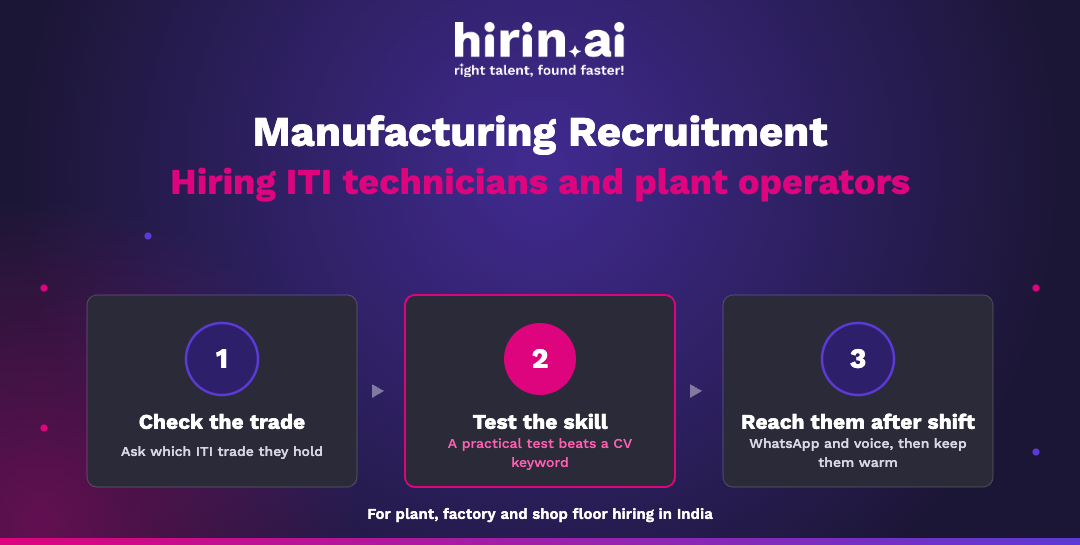
- Hire operators for reliability, shift fit and commute. Hire ITI technicians for a named trade, proven by a practical test, not by a keyword on a CV.
- ITI courses run in 169 trades (DGT, 2026), so a vague "ITI pass" tells you very little. Always ask which trade.
- If your plant has 40 or more people, the Apprentices Act may oblige you to engage apprentices, in a band of 2.5% to 10% of your manpower (DGT, 2026). Treat it as a hiring channel, not just a duty.
- In our illustrative example, filling 20 technician seats needs about 322 applicants reached. Small changes in the joining rate move that number a lot.
A fitter resigns on the 28th, a second line is due to start in three weeks, and the people you want are standing at a machine when your recruiter calls. That is manufacturing recruitment in a sentence: skilled people, shift timings, and a plant that cannot wait for a slow first round.
This guide is for HR heads, plant HR teams, hiring managers and staffing agencies who fill operator and ITI technician seats. It covers who you are actually hiring, where they come from, how the Apprentices Act fits in, how to screen without a phone bank, and how to measure whether it worked.
What we add: we explain the trade and certificate logic that general blue collar guides skip, we put the Apprentices Act and the ITI system next to your hiring plan using official sources, and we show the funnel maths for a technician batch. If you hire in bulk across several roles, our bulk hiring guide covers the wider playbook.
How is manufacturing recruitment different from other volume hiring?
A BPO batch is mostly judged on language and attitude. A plant batch is judged on trade, safety habits and whether the person will still be at the machine in the third month. Four things make it different.
| Factor | What it means on a plant | What you do about it |
|---|---|---|
| Shifts | Candidates are on the floor or asleep when recruiters call in office hours | Reach them on WhatsApp or an AI voice call at the hour that suits them |
| Trade proof | "ITI" covers many trades. A fitter, an electrician and a welder are different hires | Ask for trade, ITI name and year, then test the skill |
| Safety and fit | A wrong hire on a press or a panel is a safety issue, not just a retention issue | Use a practical test and a supervisor round before the offer |
| Commute and shift | Many drop outs come from a late shift, a long commute or a pay gap that was not discussed early | Ask about shift, travel and pay in the first screen |
Our guides on blue collar recruitment in India and blue collar vs white collar hiring cover the wider picture. Here we stay with plants and trades.
Who are you hiring: plant operators or ITI technicians?
The two get mixed up in job posts, and that is where good people get filtered out and wrong people get through. Write them as separate roles with separate must haves.
| Role | What the plant needs | Proof to ask for | How to test it |
|---|---|---|---|
| Machine or plant operator | Runs a machine or a process line to a standard, safely, on a fixed shift | Past plant experience, shift history, willingness for rotating shifts | Short skill questions, a walk through of a process, a supervisor trial run |
| ITI technician (fitter, electrician, welder, machinist and others) | A named trade skill: reading a drawing, wiring a panel, laying a weld | Trade, ITI name, year of passing, certificate, work history | Practical trade test on the shop floor, scored by a senior technician |
| Apprentice | A learner who becomes a skilled hand over one to two years | Eligibility under the Apprentices Act and the trade you designate | Aptitude, attendance record, supervisor interview |
One fact helps you set the bar for ITI hires. The Directorate General of Training (DGT) says ITI courses under the Craftsmen Training Scheme run from 6 months to 2 years and cover 169 trades, of which 86 are engineering trades (DGT, About page, accessed November 2026). It also reports 14,643 ITIs, 3,331 government and 11,312 private (DGT, Craftsmen Training Scheme page, accessed November 2026). So the pool is large, but the trade label does the real work. "ITI pass" with no trade is not a screening answer.
Where do you find operators and ITI technicians?
Most plants use several sources and lose track of which one works. Record the source on every candidate.
- ITI and polytechnic placement cells. Good for freshers and apprentice conversion. Visit early, because good batches are claimed before results.
- Your own contract and past workers. People who already know your plant, your safety rules and your shift pattern. Search your talent pool before you post a new job.
- Employee referrals. Often the steadiest source for plant roles, because the referrer has a stake. Track joiners and 90 day retention by referrer.
- Walk in drives. Useful when you need a full shift or a batch by a fixed date. Our guide to planning a walk in interview drive for 100 hires covers the stations, staffing and run sheet.
- Job boards and WhatsApp groups. Wide reach, thin detail. Many applications state no trade, so the first screen matters.
- Staffing agencies and contractors. Fast for volume. Agree the screening script and replacement terms first.
Should you hire apprentices under the Apprentices Act?
Often yes, and for some plants it is not optional. Per the DGT apprenticeship page (accessed November 2026), the Apprentices Act, 1961 makes it obligatory for employers with 40 or more people and the required training infrastructure to engage apprentices. The band is 2.5% to 10% of total manpower strength, including contractual staff. Trade apprentices train for a period that runs from one year and two months up to two years, and 261 trades in 39 trade groups are designated. The employer bears the stipend for trade apprentices, at a minimum of 70% of the state minimum wage for semi skilled workers in year one, 80% in year two and 90% in years three and four.
Here is what that looks like for a plant. The figures are illustrative assumptions, not your plant and not a statement of what applies to you. Check the Act and your state rules.
| Item (illustrative) | Assumption | Result |
|---|---|---|
| Total manpower including contract staff | Assumed | 400 |
| Lowest apprentice engagement | 2.5% of 400 | 10 |
| Highest apprentice engagement | 10% of 400 | 40 |
| State minimum wage, semi skilled (hypothetical) | ₹15,000 a month | ₹15,000 |
| Minimum stipend, year one | 70% of ₹15,000 | ₹10,500 |
| Minimum stipend, year two | 80% of ₹15,000 | ₹12,000 |
| Minimum stipend, years three and four | 90% of ₹15,000 | ₹13,500 |
The stipend is a cost, so count it. The upside is a trained pipeline: apprentices learn your machines and your safety rules, and the best of them become your next fitters or electricians without a notice period to negotiate. Whether that beats hiring ready technicians depends on your attrition and training capacity.
How do you screen operators and technicians without a phone bank?
Screen in the order of what kills a hire fastest. Basics first, skills second.
- Trade, certificate and experience. Which trade, which ITI, which year, and where they worked last. AI screening can read each CV against the trade, certificate and experience you set and show its reasons.
- Shift, commute and pay. Ask the three questions that cause the most drop outs: can you work this shift pattern, how will you travel, and does this pay range work for you. Do it on the first contact, not at the offer.
- A short first round on the candidate's phone. A WhatsApp chat or an AI voice call in English, Hindi and 22+ Indian languages lets people answer after their shift. Keep it to a few minutes.
- A practical or role based test. For technicians, a trade test on the floor scored by a senior technician. For quality and maintenance roles, a role based test through AI skill assessment can come first, so only people who pass travel to the plant.
- A supervisor round. The person who will lead the shift meets the candidate. This is where safety attitude and team fit show.
- Documents early. Ask for the certificate, ID and previous employer details soon after the first screen, so a missing paper does not surface on joining day.
One rule worth writing into your process: nobody is rejected by a rule or a score alone. The screen reads, ranks and shows reasons. A person on your team makes the final call on every candidate, and should say why to anyone who does not go forward.
See this on one of your plant roles
WhatsApp and AI voice screening after shift, every CV read against the trade, and one pipeline for every plant.
Worked example: how many applicants do you need for 20 ITI technicians?
Say a plant needs 20 ITI technicians to start on a fixed date. Work backwards from joiners, using your own pass rates. The rates below are illustrative assumptions, not Hirin data and not benchmarks. Replace each one with numbers from your last hiring batch.
| Stage (illustrative) | Assumed rate | People needed |
|---|---|---|
| Joined on day one | Target | 20 |
| Offers made | 65% of offers join | 31 |
| Supervisor interviews | 70% of interviewed get an offer | 45 |
| Practical trade tests | 50% of those tested reach the interview | 90 |
| First screen passed | 40% of those screened reach the trade test | 225 |
| Applicants reached | 70% complete the first screen | 322 |
Check it from the top. 322 reached at 70% gives 225 screened (225.4). At 40% that is 90 for the trade test (90.2). At 50% that is 45 for the supervisor round (45.1). At 70% that is 31 offers (31.6). At 65% that is 20 joiners (20.5, rounded down to the 20 you need).
Now see how sensitive it is. If you lift the joining rate from 65% to 80% by keeping candidates warm, you need 25 offers instead of 31 (20 ÷ 0.8). Working back through the same rates, that is 36 interviews, 72 trade tests, 180 screened and 258 applicants reached, about 64 fewer than before. A small gain at the end of the funnel removes a lot of work at the start.
How do you stop candidates dropping out between offer and day one?
For technicians with a job today, the gap between offer and joining is where you lose people to a counter offer, a notice period dispute or a better shift elsewhere. For freshers it is more about doubt, family opinion and travel. The fixes are mostly boring and consistent.
- Be clear in writing. Send the offer with shift, location, pay components and joining date on WhatsApp, and record the acceptance.
- Check in at set points. At acceptance, at resignation, at the relieving date and in the week before joining. Silence is the main cause of no shows.
- Let candidates pick the interview slot. Booking and rebooking on WhatsApp through AI interview scheduling saves calls back and forth with supervisors. Interview slots can sync with Google Calendar and Outlook Calendar.
- Keep a waitlist. Rank the near misses and tell them honestly where they stand, so a drop out is replaced in a day, not a week.
Our post on the offer to joining ratio shows how to calculate it.
When this does not apply
- Senior and leadership roles. Plant heads, production managers and R&D chemists are fewer, harder hires. A funnel of hundreds does not fit them. Use targeted search and structured interviews instead.
- Weak rate history. The worked example needs your own pass rates. For a new plant, city or trade, run a small pilot batch first and use those numbers.
- The Apprentices Act section. We summarised it from the DGT page, not from a legal text. Whether it applies to you, and how your state sets stipend and minimum wage, needs your legal or compliance team.
- Candidate data. You collect IDs, certificates and phone numbers. Tell candidates what you collect and why, as India's Digital Personal Data Protection Act, 2023 expects, and ask your counsel which provisions apply today.
How to measure it
Pick one role family, such as fitters or electricians, and track it for at least four weeks before you change anything. Then compare like with like: the same trade, the same plant and the same season.
| Measure | How to calculate it | What it tells you |
|---|---|---|
| Trade test pass rate | Passed divided by tested | Whether your screen sends the right people to the floor |
| Show up rate | Attended test or interview divided by invited | Whether reminders and slots work |
| Offer to joining | Joined divided by offers made | What you lose after the offer |
| 30 and 90 day retention | Still in role at day 30 and day 90 divided by joined | Whether you hired the right people |
| Time to fill | Days from approved requisition to joining | The number the plant head cares about |
Add a quality check: each week, have a recruiter review a sample of candidates who did not go forward, to be sure the screen is not turning away people who would have done well. A plant wise view of open seats and stuck roles through recruitment analytics helps leadership see which plant is slow. Remember that recruiter time saved is capacity, not cash, until it replaces overtime, a contractor or a planned hire.
Frequently asked questions
How do you hire ITI technicians?
What is the difference between a plant operator and an ITI technician?
Is hiring apprentices compulsory for a manufacturing plant?
Can you screen shift workers on WhatsApp?
How many applicants do I need for 20 technician hires?
How we researched this
The facts on ITIs, trades and the Apprentices Act come from the Directorate General of Training pages listed below, opened in November 2026. The funnel and stipend tables are illustrative assumptions, not Hirin platform data and not benchmarks. The product details come from Hirin.ai's manufacturing page. We did not open the text of the Act itself, so check it with your legal team. DGT pages show different trainee totals, so we cite only the ITI count and trade numbers.
- Directorate General of Training, Ministry of Skill Development and Entrepreneurship, About DGT (169 trades, 86 engineering trades, course duration 6 months to 2 years, accessed November 2026).
- Directorate General of Training, Craftsmen Training Scheme (14,643 ITIs, of which 3,331 government and 11,312 private, accessed November 2026).
- Directorate General of Training, Apprenticeship Training (Apprentices Act, 1961, 40 or more manpower, 2.5% to 10% band, stipend rates, 261 designated trades, accessed November 2026).
- Hirin.ai, AI recruitment software for manufacturing (product page, read November 2026).

Vikas Agarwal
Vikas Agarwal is the founder of Hirin.ai, an AI recruitment platform that screens, interviews and shortlists candidates for Indian hiring teams and staffing agencies. He has spent years building digital products and now works on the hiring problems recruiters raise every day. He writes about AI in recruitment, staffing and the future of work.