

On this page
- What does screening a resume involve?
- What should you screen for on an Indian CV?
- How do you build a resume screening scorecard?
- Worked example: screening 200 CVs for a collections role
- What does research say about screening CVs?
- Where does AI resume screening help, and where doesn't it?
- When doesn't this approach work?
- How do you know your screening is working?
- Frequently asked questions
- How we researched this
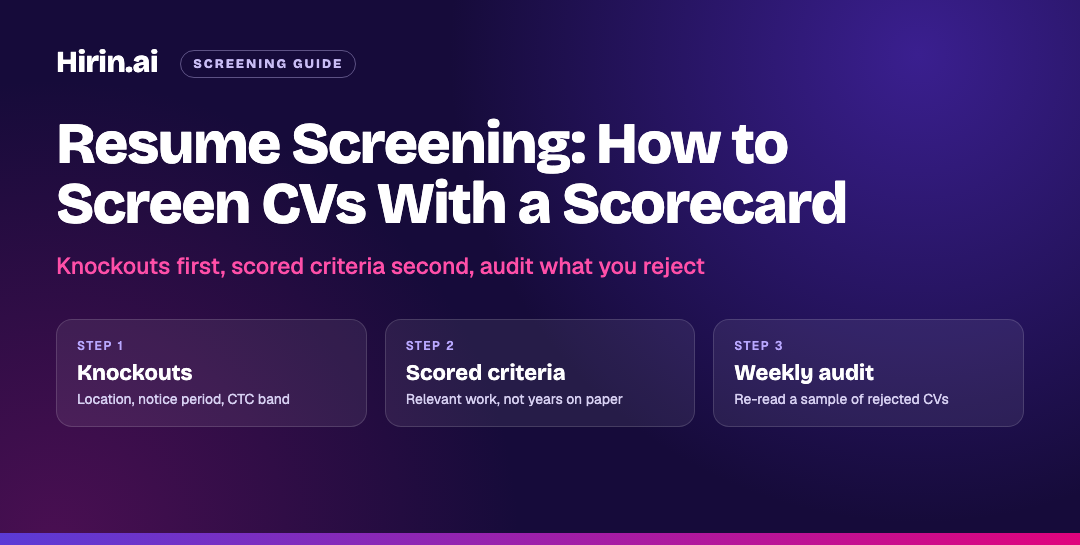
- Split criteria into knockouts (pass or fail, checked in seconds) and scored criteria (read with care). Most screening time goes on CVs that should have failed a knockout.
- On Indian CVs, the usual knockouts are location, notice period and CTC band. Many CVs leave these out, so ask for them in the application or the first message.
- Years of experience is a weak signal. A 2022 meta-analysis put its link to job performance at 0.07, against 0.42 for structured interviews. Score relevant work, not the total.
- Never score name, photo, age, gender, religion or caste signals. Field experiments in the US and Delhi found callbacks changed with the name on an otherwise similar CV.
- Read a sample of rejected CVs every week. It is the only way to see the good people your filters are losing.
What does screening a resume involve?
Resume screening (or CV screening) is the step between receiving applications and speaking to anyone. A recruiter reads each CV against the role and sorts it into three piles: move forward, hold, or reject. It comes after sourcing and resume parsing, which turns a CV into fields, and before the phone or WhatsApp screen.
For a recruitment agency the step carries extra weight. Every CV you submit to a client is a judgement on your desk. Send too many and the client stops reading; send too few and a competing agency fills the role. A good screen is fast on the obvious no's and careful on the close calls.
What should you screen for on an Indian CV?
Each criterion is either a knockout or a scored item. Knockouts are facts that end the conversation whatever else the CV says. Scored items need reading and judgement. Keep knockouts few: every extra one throws out people who could have done the job.
| Criterion | Knockout or scored? | How to check it | Watch out for |
|---|---|---|---|
| Location or willingness to relocate | Knockout | Current city on the CV, then confirm in the first message | Candidates applying from a hometown while working elsewhere |
| Notice period | Knockout | Ask directly; note whether the employer allows a buyout | "Serving notice" CVs that already hold another offer |
| Current and expected CTC against the client's band | Knockout | Ask in the application form or first message | Fixed versus variable pay quoted as one number |
| Must-have licence, certification or degree | Knockout only if the role or a regulator requires it | Named on the CV; verify documents later | Degree filters added out of habit, not need |
| Relevant work (tasks, tools, domain) | Scored, 0 to 2 | Read what the person did, not the job title | Titles mean different things at different firms |
| Language for the role | Scored, or a knockout for voice processes | Test it on a short call or voice screen, not from the CV | Judging spoken English from written English |
| Total years of experience | Scored lightly, if at all | Use a range, not a minimum | Rejecting a strong 2-year profile for a "3+ years" line |
| Gaps and short stints | Not a knockout | Ask about them on the call | Caregiving, study and layoffs all leave gaps |
| Name, photo, age, gender, religion, caste signals | Never scored | Hide them during the screen if your tools allow | These drive bias, as the research below shows |
Many CVs on job boards leave out notice period and expected CTC, so you can't apply those knockouts from the CV alone. Add two or three short questions to the application, or send them as the first WhatsApp message. If you source from Naukri, our guide to searching Resdex shows which of these fields you can filter on before you download a CV.
How do you build a resume screening scorecard?
- Get the brief from the client or hiring manager. Ask what the person will do in the first 90 days, what has made past hires fail, and which requirements are truly fixed. Our intake meeting template has the questions.
- Pick no more than three or four knockouts. Write each one as a yes or no question: "Can join within 30 days?" not "Short notice preferred".
- Pick three or four scored criteria and score each 0, 1 or 2. Write one line for what a 2 looks like, for example "has handled inbound collections calls for a bank or NBFC".
- Calibrate on ten CVs. Score ten CVs yourself, send them to the client with your scores, and ask where they disagree. Adjust the criteria once, before you screen the whole pile.
- Set the cut-off and the hold pile. For example, 5 or more out of 8 goes forward, 3 or 4 goes on hold, and anything lower is rejected with a message.
- Write a one-line reason for every decision. It makes the weekly audit possible and gives the client a reason with each submitted CV.
Worked example: screening 200 CVs for a collections role
An agency desk is filling a tele-collections role for an NBFC client in Pune and receives 200 applications. All figures below are illustrative assumptions, not Hirin customer data or platform averages. Use your own.
| Scorecard item | Type | Candidate A | Candidate B | Candidate C |
|---|---|---|---|---|
| Based in Pune or will relocate | Knockout | Yes | Yes | No (Nagpur, will not move) |
| Can join within 30 days | Knockout | Yes (15 days) | Yes (immediate) | Yes |
| Expected CTC inside the client's band | Knockout | Yes | Yes | Yes |
| Collections or recovery calling experience | Scored 0 to 2 | 2 | 1 (sales calls only) | Not scored |
| Marathi and Hindi for customer calls | Scored 0 to 2 | 2 | 2 | Not scored |
| Uses a dialler or CRM | Scored 0 to 2 | 1 | 2 | Not scored |
| Stayed 9+ months in a calling role | Scored 0 to 2 | 1 | 2 | Not scored |
| Result | Cut-off 5 of 8 | 6: forward | 7: forward | Rejected on location |
Candidate B has less direct collections experience than A but scores higher overall. That is the point of a scorecard: the decision rests on criteria the client agreed to, not on whichever CV was read first or looked most polished.
How long does it take?
Here is the same 200-CV role screened by hand with the scorecard, and with AI resume screening doing the first pass. Every figure in the table is an illustrative assumption.
| Step | By hand with a scorecard | Minutes | With AI doing the first pass | Minutes |
|---|---|---|---|---|
| Knockout pass | 200 CVs × 1 min | 200 | AI checks knockouts on every CV | 0 |
| Scored read of CVs that pass (assume 80) | 80 × 4 min | 320 | Recruiter reviews 80 AI summaries with reasons × 1.5 min | 120 |
| Rejected-pile audit | 10 rejected CVs × 2 min | 20 | 20 rejected CVs × 1.5 min (larger sample, because a machine made the cut) | 30 |
| Calibration with the client | One 30-minute call | 30 | One 30-minute call | 30 |
| Total | about 9.5 hours | 570 | about 3 hours | 180 |
That is 6.5 recruiter hours freed per 200-CV role (illustrative). At a loaded recruiter cost of ₹340 an hour (₹5 lakh a year CTC, 160 working hours a month, plus 30% overheads; also illustrative), that is about ₹2,210 per role, or about ₹33,000 a month for a desk running 15 such roles. Read this as the value of recruiter time freed, before software cost. It is capacity, not cash: it lowers your spend only if the hours replace overtime, a contractor or a recruiter you would otherwise hire. For agencies the more common gain is more roles worked per recruiter. Subtract the software subscription, usage charges and setup before calling anything a saving. Our cost per hire worked example shows how to net them out.
What does research say about screening CVs?
- Experience in years predicts little. Sackett, Zhang, Berry and Lievens (2022) re-estimated the validity of common selection methods. Their estimate for years of job experience is 0.07, down from 0.18 in the older Schmidt and Hunter summary. Structured interviews came out on top at 0.42, and job knowledge tests at 0.40. This is outside research across many jobs and countries, not a Hirin result. The practical point: a "minimum 3 years" knockout throws away people for a weak reason.
- Names change callbacks. In a US field experiment, Bertrand and Mullainathan sent fictitious CVs to job ads in Boston and Chicago. CVs with white-sounding names received 50% more callbacks than otherwise similar CVs with African-American-sounding names. That is a relative difference, from US data.
- The Delhi version found it in one sector but not another. Banerjee, Bertrand, Datta and Mullainathan sent 3,160 fictitious CVs to 371 openings in and around Delhi. They found no evidence of caste discrimination for software jobs, but significant callback gaps between upper-caste and OBC applicants for call-centre jobs. They found no evidence of discrimination against Muslim applicants in either sector. The study is from 2009, so treat it as a reason to check your own process, not as a current rate.
- Automated filters do much of the first cut already. In the Harvard Business School and Accenture "Hidden Workers" survey of employers in the US, UK and Germany, more than 90% of employers that used a recruitment management system relied on it to make the first cut or rank applicants. The authors argue that rigid filters exclude capable people. Their survey did not cover India.
Put together: keep knockouts to facts that truly end the conversation, score relevant work rather than tenure, hide identity signals while you score, and check what your filters reject. That applies to a recruiter's eyes and to software alike.
Where does AI resume screening help, and where doesn't it?
AI screening is good at the part of the job that is reading at volume: applying the same knockouts and criteria to every CV, at any hour, and showing a reason for each score. It is no better than the scorecard you give it, and it cannot confirm that a CV is true. For a step-by-step look at the mechanics, see how AI resume screening works, and for speed, cost and quality side by side, our AI vs manual screening comparison.
| Task | Who should do it |
|---|---|
| Agreeing knockouts and scored criteria with the client | Recruiter |
| Checking knockouts on every CV | AI |
| Asking for missing notice period and CTC | AI, by WhatsApp or an AI voice screening call |
| Scoring relevant work, with a reason shown | AI, reviewed by the recruiter |
| Close calls in the hold pile | Recruiter |
| Auditing the rejected pile | Recruiter |
| Deciding who to submit to the client | Recruiter |
Run your scorecard on every CV
Knockouts and criteria applied to each application, a reason shown for every score, and a ranked shortlist your recruiters review.
When doesn't this approach work?
- Senior and executive search. With ten candidates, most of them headhunted, a scorecard still helps, but knockouts and volume tools add little. Most of the judgement happens in conversation.
- Roles where the CV says little. For many blue-collar and entry-level roles, candidates have thin or no CVs. Screen with three short questions on WhatsApp or a call instead of reading a document.
- A brief that keeps changing. If the client changes the criteria after every submission, recalibrate before screening more. Scoring against an old brief wastes everyone's time.
- Screening is not verification. A CV that passes the screen still needs reference, document and background checks where the role requires them.
- Candidate data. Under India's Digital Personal Data Protection Act, 2023, collect only what you need for the role, tell candidates why, and set how long you keep CVs you reject.
How do you know your screening is working?
- Pass rate at each step: applications, knockout pass, shortlist, submitted, interviewed, offered, joined. A sudden drop at one step shows where the criteria are off.
- Client acceptance of submitted CVs (for agencies): the share of submissions the client agrees to interview. Falling acceptance usually means the scorecard has drifted from the brief.
- Miss rate in the rejected-pile audit: how many of the sampled rejects a recruiter would have moved forward. Track it weekly per role.
- Time from application to first contact. Good candidates take other offers while they wait.
- Quality after the hire: joining rate and 90-day retention for people who passed the screen. Recruitment analytics puts the funnel in one place.
For the wider screening process beyond CVs, including voice and WhatsApp first rounds, see our guide to automated candidate screening. Agencies weighing tools for the whole desk can start with recruitment agency software.
Before you read a CV in detail, a short set of pre screening questions can settle notice period, location and pay fit. Our guide lists the questions recruiters should ask, by role.
Frequently asked questions
What is resume screening in recruitment?
How long should it take to screen one resume?
What are knockout questions in resume screening?
Can AI do resume screening on its own?
How do you reduce bias when screening resumes?
How we researched this
The scorecard and knockout fields reflect how Indian recruitment agencies commonly screen, with the research below used only for the points it tested. The worked example and time table use stated, illustrative assumptions, not Hirin customer data or platform averages. Each source was opened and checked on 26 Oct 2026.
- Sackett, P. R., Zhang, C., Berry, C. M. and Lievens, F. (2022), Revisiting meta-analytic estimates of validity in personnel selection, Journal of Applied Psychology, 107(11), Table 3.
- Bertrand, M. and Mullainathan, S., Are Emily and Greg More Employable than Lakisha and Jamal?, NBER Working Paper 9873.
- Banerjee, A., Bertrand, M., Datta, S. and Mullainathan, S. (2009), Labor market discrimination in Delhi: Evidence from a field experiment, Journal of Comparative Economics, 37(1).
- Fuller, J. B., Harvard Business School, How to tap the talent automated HR platforms miss (summary of the Hidden Workers: Untapped Talent report with Accenture, 2021).
- Ministry of Electronics and IT, Digital Personal Data Protection Act, 2023.

Vikas Agarwal
Vikas Agarwal is the founder of Hirin.ai, an AI recruitment platform that screens, interviews and shortlists candidates for Indian hiring teams and staffing agencies. He has spent years building digital products and now works on the hiring problems recruiters raise every day. He writes about AI in recruitment, staffing and the future of work.