

On this page
- Which parts of cost per hire does AI screening cut?
- Where do the savings come from?
- What have Hirin customers reported?
- What does outside research say?
- Worked example: what does a 50-hire BPO drive cost to screen?
- When doesn't AI screening reduce cost per hire?
- How do you measure the saving in your own team?
- Frequently asked questions
- How we researched this
- Screening cost is mostly internal: recruiter and hiring-manager time. That is the line AI screening cuts hardest.
- Freed time is capacity, not cash. It becomes a budget saving when it cuts overtime, contractors, agency fees or a planned hire.
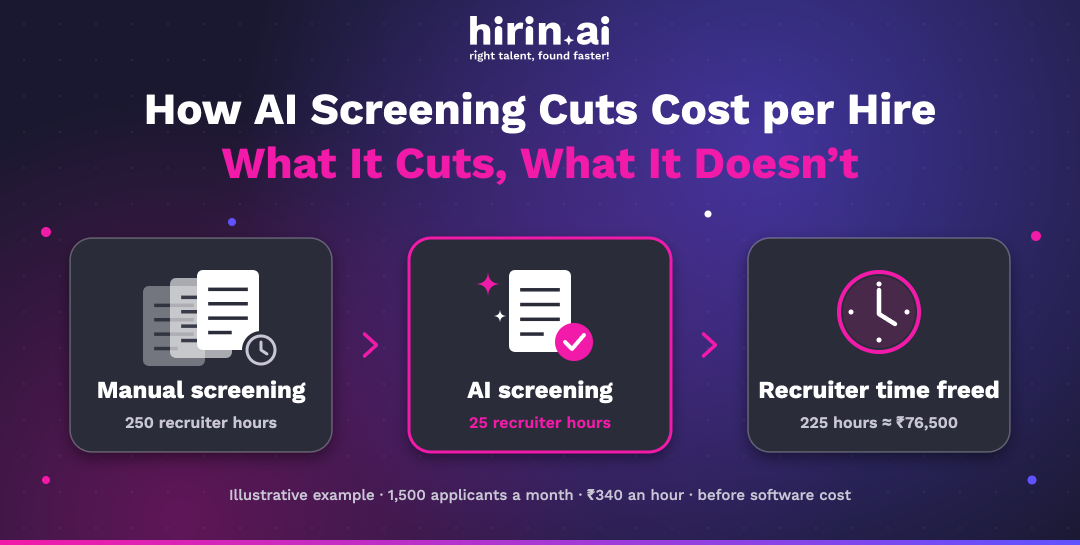
- In our illustrative example, 1,500 applicants a month at 10 versus 1 minute each frees about 225 recruiter hours, worth about ₹76,500 before software cost.
- Whether it pays back depends on total monthly volume, minutes saved, hourly cost, software and setup, not on applicants per role.
Which parts of cost per hire does AI screening cut?
Cost per hire, as defined in the ANSI/SHRM standard, is your external recruiting costs plus your internal recruiting costs, divided by the number of hires in the same period. Internal costs include the fully loaded cost of your recruiting team, which is why freed recruiter time lowers cost per hire on paper even before it changes your budget. Our cost per hire guide covers the full formula and Indian benchmarks. Here the question is narrower: which of those lines does AI candidate screening actually touch?
| Cost line | Type | Does AI screening cut it? | Why |
|---|---|---|---|
| Recruiter time reading CVs | Internal | Yes, a lot | AI screening reads every CV and scores it against the role, with reasons shown |
| First-round phone screens | Internal | Yes, a lot | WhatsApp questions or an AI voice call run the first round, at any hour |
| Scheduling and chasing no-shows | Internal | Yes | Candidates answer when it suits them, and automated scheduling books the rest |
| Hiring-manager review time | Internal | Partly | Managers see a ranked shortlist with answers, not a pile of CVs |
| Agency fees | External | Partly | Faster in-house screening can mean fewer roles handed to agencies |
| Re-posting jobs and re-hiring | External | Partly | Fewer roles go stale while candidates wait for a first round |
| Job boards and advertising | External | No | You still pay to reach applicants |
| Background checks, onboarding | External | No | These happen after the hire decision |
| Screening software and usage | External | Adds a cost | Subscription, per-screen or per-call charges, and setup |
So expect a large drop in screening time and a smaller drop in total cost per hire once software is counted. How large depends on how much of your cost per hire is recruiter time. For high-volume roles like BPO, retail and field sales, it is usually the biggest line.
Where do the savings come from?
1. Recruiter time freed per hire
Manual screening scales with applicants: twice the CVs, twice the hours. AI screening reads every CV in minutes (here is how it ranks them), and recruiters spend their time on the shortlist instead of the pile. In cost-per-hire terms, this lowers the internal cost allocated to each hire. In budget terms it is freed capacity: it turns into money saved only when it cuts overtime, contractor or agency spend, or a recruiter you would otherwise hire.
2. Workload grows more slowly with volume
Every applicant still needs some human attention, such as reviewing a shortlisted summary or spot-checking a rejection, so recruiter time still rises as volume rises. It rises far more slowly than with a manual read and a phone call for each applicant. Check how your tool is priced too: per-screen or per-call charges also grow with volume and belong in the calculation.
3. Fewer drop-outs from slow first rounds
Candidates with other offers drop out while they wait for a first-round call. Screening the same day an application arrives shortens that wait, and each drop-out avoided is a hire you don't source twice. Measure this in your own funnel rather than assuming it; our guide to the offer-to-joining ratio shows what to track.
4. Earlier starts, a separate benefit
Filling a seat sooner has value: billable work starts earlier in a BPO or staffing agency, sales start earlier in a field team, and overtime for the people covering stops sooner. This is real, but it is business value from earlier starts, not a reduction in cost per hire, so keep it out of your cost-per-hire maths. We show how faster screening plays out in BPO hiring.
What have Hirin customers reported?
Results after adopting Hirin's hiring workflow
Each customer's HR team reported these after adopting several Hirin features together, including AI screening, so they don't isolate the effect of screening alone. The case studies don't yet publish the measurement period, number of hires or the cost lines counted. Sources: GrowExx case study (GrowExx is Hirin's parent company) and Matangi Industries case study.
"My team now handles twice the applications in a quarter of the time, and we fill roles 70% faster."
Dhaval Vora, Senior Manager, HR and Recruitment, GrowExx (read the case study)
What does outside research say?
A field experiment by Jabarian and Henkel, with about 70,000 applicants for call-centre jobs, found that applicants whose interview was run by an AI voice agent were 12% more likely to receive a job offer than those interviewed by human recruiters, with gains carrying through to job starts and retention (study). That is a relative increase, not 12 percentage points, and human recruiters still made the hiring decisions. It is outside research on AI voice interviews, not a Hirin result, and it does not measure cost per hire.
Worked example: what does a 50-hire BPO drive cost to screen?
Take a BPO voice process hiring 50 agents a month, with about 30 applicants per hire. That is 1,500 applicants to screen. The numbers below are illustrative assumptions, not Hirin customer data; swap in your own in the calculator.
| Screening step | Manual | Hours | With AI screening | Hours |
|---|---|---|---|---|
| Read CVs | 1,500 × 4 min | 100 | AI scores every CV and runs the first round on WhatsApp or a voice call | 0 |
| Phone screen | 600 (40%) × 12 min | 120 | ||
| Schedule and chase | 600 × 3 min | 30 | ||
| Review shortlist | Included above | 300 AI summaries × 3 min | 15 | |
| Set-up and spot checks | Rubric, criteria, sample checks | 10 | ||
| Total recruiter hours | about 10 min per applicant | 250 | about 1 min per applicant | 25 |
That is 225 recruiter hours freed a month, worth about ₹76,500 at a loaded cost of ₹340 an hour (₹5 lakh a year CTC, 160 working hours a month, plus 30% overheads). Read that as the value of recruiter capacity freed, before software cost. It lowers cost per hire as the ANSI/SHRM standard counts it, because internal staff time is part of the formula. It lowers your monthly spend only if the freed hours replace overtime, contractors, agency fees or a recruiter you would otherwise hire.
For the net change in recruiting cost, subtract the software subscription, any usage charges, and setup spread over a year. With a hypothetical ₹20,000 a month for software and ₹30,000 of one-time setup (not Hirin's pricing), the net is about ₹54,000 a month.
Earlier starts are a separate benefit. If same-day screening fills each seat 5 days sooner, and each seat-day filled earlier is worth ₹1,000 to you in contribution or avoidable cost (illustrative; lost billing is not all profit), that is 50 × 5 × ₹1,000 = ₹2,50,000 a month of earlier-start value. Report it next to cost per hire, never added to it.
When does it pay back?
Break-even depends on total monthly volume, not applicants per role. Each applicant screened with AI frees (minutes saved ÷ 60) × hourly cost. In the example that is 9 ÷ 60 × ₹340 = ₹51 per applicant, so ₹22,500 a month of software and setup needs about 442 applicants a month across all roles. Ten applicants per role across 50 roles clears that; one role a month with 100 applicants does not.
Estimate the effect on your recruiting cost
Defaults match the worked example. Change any field; results can be negative.
Time freed is capacity, not cash, until it replaces overtime, contractors, agency fees or a planned hire. The software and setup defaults are hypothetical, not Hirin's pricing; enter your own quote. To model sourcing and scheduling as well, use the recruiting ROI calculator.
See AI screening on your own roles
Every CV scored with reasons, first rounds on WhatsApp and voice, one ranked shortlist.
When doesn't AI screening reduce cost per hire?
- Not enough total volume. If minutes saved × hourly cost across all your monthly applicants doesn't cover software and setup, it won't pay back. Check break-even with the calculator above.
- Treating freed time as cash. If freed hours aren't redeployed and don't replace overtime, contractors or a planned hire, your budget doesn't change, even though cost per hire falls on paper.
- Vague criteria. AI screens against the brief you give it. A loose brief gives a loose shortlist, and the hours come back as extra interviews.
- A first round candidates won't finish. Long question sets, English-only voice calls for Hindi-speaking applicants, or links that don't work on a phone all cause drop-offs. Keep the first round short, mobile-first and in the candidate's language.
- No human check. Spot-check rejected profiles every week. Missing good people costs more than reading a few extra CVs.
- Ignoring compliance. Under India's Digital Personal Data Protection Act, 2023, tell candidates what you collect and why, and set how long you keep their data.
How do you measure the saving in your own team?
- Take a baseline of at least 4 weeks for one role family: applicants, recruiter hours on screening, time to fill and cost per hire.
- Compare like with like. Use the same role types before and after. Better still, run AI screening on some comparable roles while others stay manual over the same weeks, so seasonality and applicant mix don't skew the result.
- Track quality, not just cost: first-round completion, offer acceptance, joining rate, 90-day retention, and a weekly sample of rejected candidates reviewed by a recruiter. Recruitment analytics shows the funnel in one place.
- Add software, usage and setup costs and recalculate cost per hire with the ANSI/SHRM formula.
- Report three lines monthly: recruiter time freed, net change in recruiting cost, and earlier-start value. Our guide to measuring the ROI of AI recruiting lists the metrics to track.
Frequently asked questions
How much does AI screening reduce cost per hire?
Is AI screening worth it for a small team?
Does AI screening replace recruiters?
How do you calculate cost per hire?
Is AI screening allowed under India's DPDP Act?
How we researched this
The cost lines follow the ANSI/SHRM cost-per-hire standard. The worked example and calculator use stated, illustrative assumptions, not Hirin platform averages. Customer figures are as reported in Hirin's published case studies and cover Hirin's wider hiring workflow, not screening alone.
- SHRM, ANSI/SHRM 06001.2012 Cost-per-Hire Standard.
- Jabarian, B. and Henkel, L., Voice AI in Firms: A Natural Field Experiment on Automated Job Interviews, arXiv 2607.28222.
- Hirin.ai, GrowExx case study and Matangi Industries case study.
- Ministry of Electronics and IT, Digital Personal Data Protection Act, 2023.

Vikas Agarwal
Vikas Agarwal is the founder of Hirin.ai, an AI recruitment platform that screens, interviews and shortlists candidates for Indian hiring teams and staffing agencies. He has spent years building digital products and now works on the hiring problems recruiters raise every day. He writes about AI in recruitment, staffing and the future of work.